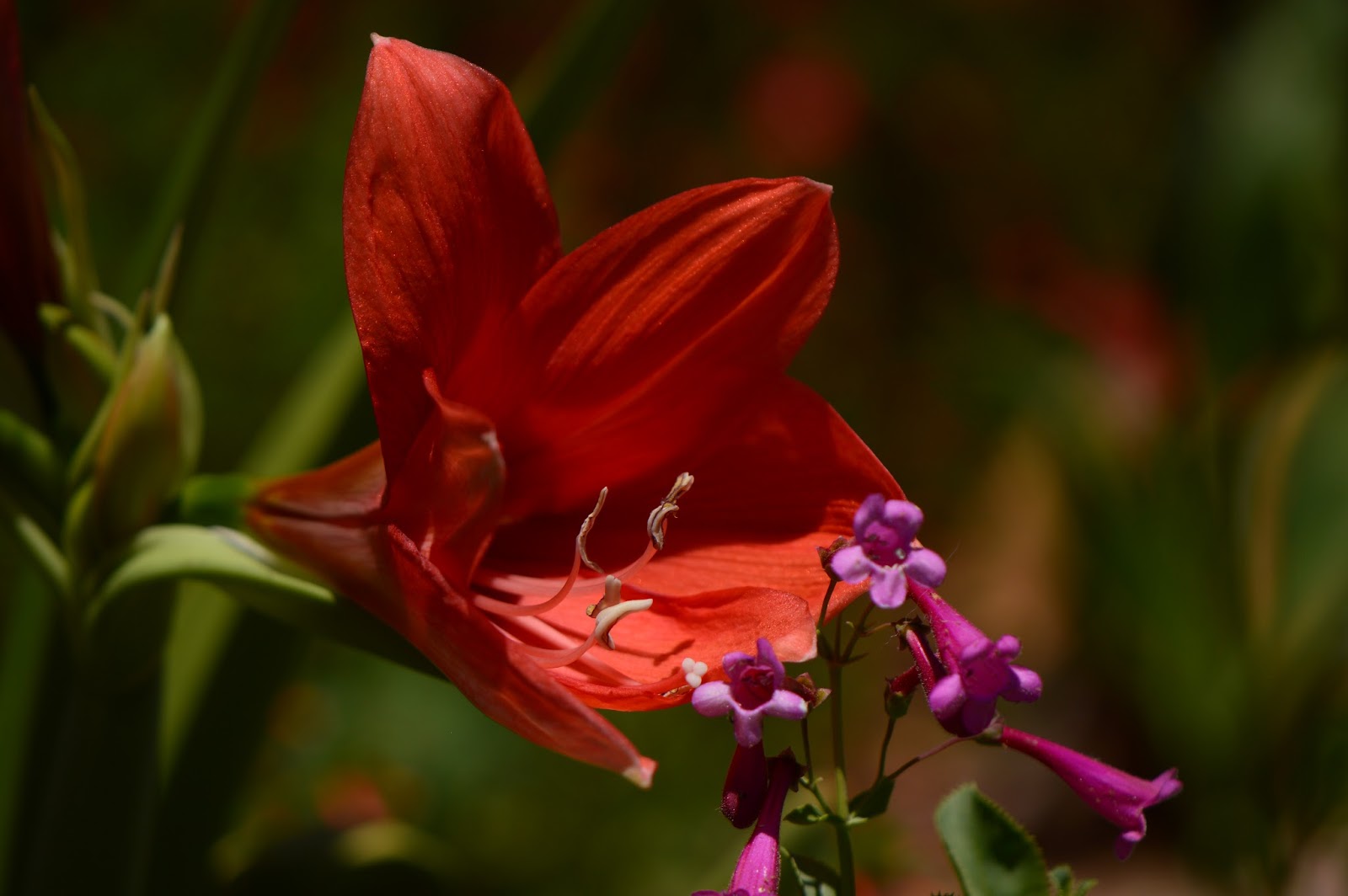
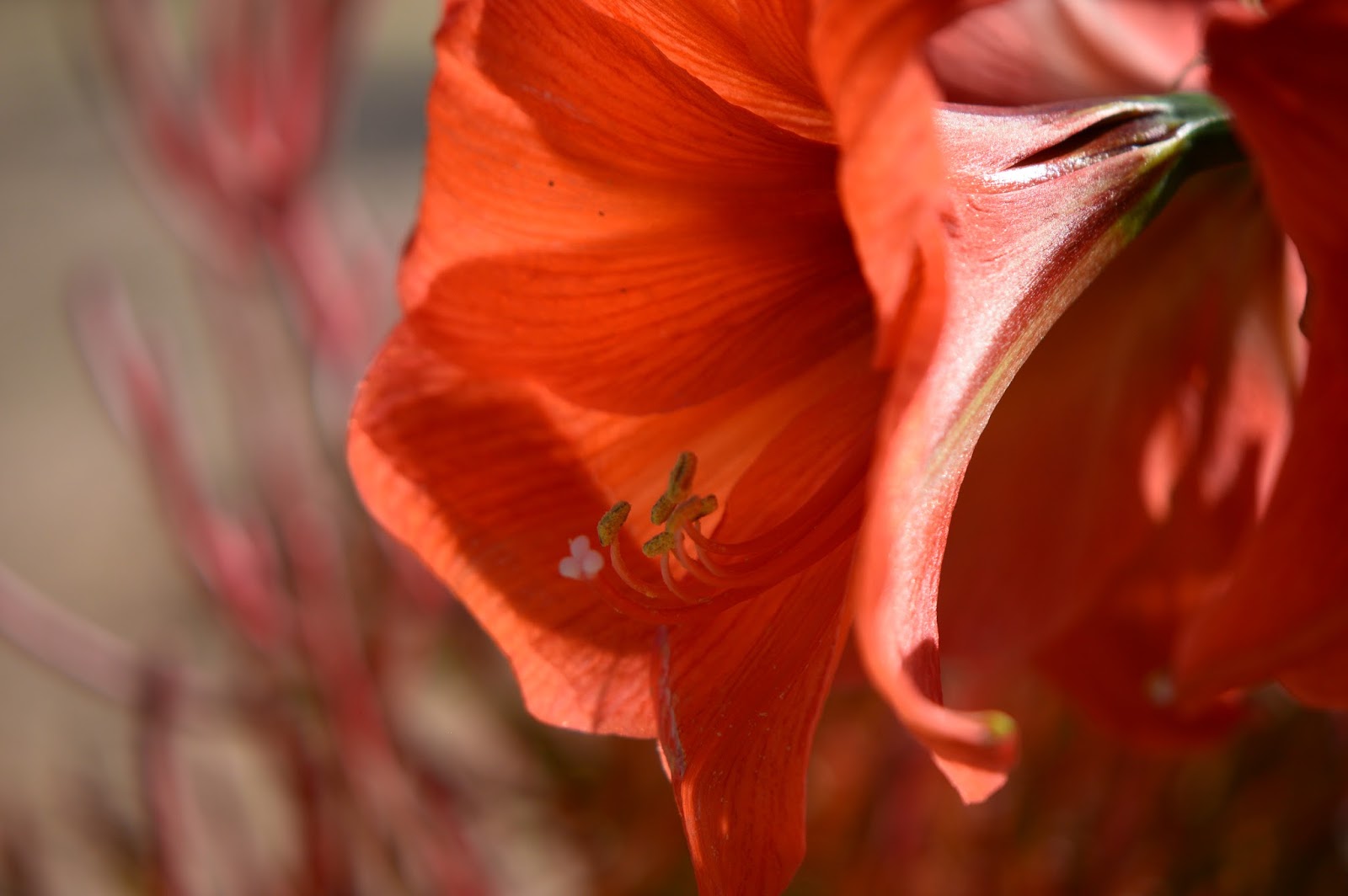
As I was going around taking photos for Bloom Day, I discovered an unexpected bud.
Hippeastrum "Naranja" outdid itself last Christmas with two enormous heads of bloom. When it was finished flowering, I planted it out in the garden. I certainly was surprised to see it ready to have another go at blooming. In this weather, too...
By yesterday the first bud was breaking open. This morning two blooms are open.
It makes an interesting match with its near neighbor, Penstemon pseudospectabilis. I didn't expect P. p. to still have flowers this time of year either!
Quite a dash of color!
Weather Diary: Fair and hot; High: 103 F (39 C)/Low: 70 F (21 C); Humidity: 5%-29%
A small garden in the English style, set in the wilds of the northern Sonora Desert...
Showing posts with label Hippeastrum. Show all posts
Friday, June 17, 2016
Friday, April 29, 2016
Spring Bulbs Report
The flowering bulb season has drawn to an end for this, the garden's second spring. So it seems like a good time to review what I have learned. (I am including cormous plants as well as true bulbs in this post since their uses in the garden are quite similar.)
I had a good many more types of bulbs to try this year than last. In particular, there were some that were not officially "spring bulbs", but which proved to be exactly that. Types such as Ixia and Hippeastrum have certainly rounded out my ideas of what the season could mean in the desert garden.
So here is an encyclopedia of sorts, covering my experiences so far:
Planted in the green in late spring of 2015. One of the first cormous plants to bloom this year and very successful. Healthy plants and heavy bloom. These were placed in an area that receives at least a half day's shade. I think they would also do well with a little more sun (see below). Wonderful color and fragrance. In their current location, they were not over-demanding of water.
The season could, in fact, have extended a good deal longer; but until now I have focused on the early-flowering types, not knowing just when they would bloom here or how soon summer's heat might set in. Watching two springs in the garden, I am sure I will be using some of the later varieties by next year.
All in all, spring of 2016 was encouraging in the matter of bulbs. I realize now that, being decidedly seasonal, many of these plants might be better off in the sunniest spots in the garden; with the early bloomers, at least, there is no priority for shade, as there is with summer plants.
Differences in drainage throughout the garden may play a role also. I have always found narcissus fairly tolerant of clay, for instance. And I hope that as I can improve the soil regularly, more of these bulbs will settle in to bloom year after year.
Weather Diary: Fair; High: 75 F (24 C)/Low: 62 F (17 C)
I had a good many more types of bulbs to try this year than last. In particular, there were some that were not officially "spring bulbs", but which proved to be exactly that. Types such as Ixia and Hippeastrum have certainly rounded out my ideas of what the season could mean in the desert garden.
| Hippeastrum "Ambiance" |
Freesia
Planted in the green in late spring of 2015. One of the first cormous plants to bloom this year and very successful. Healthy plants and heavy bloom. These were placed in an area that receives at least a half day's shade. I think they would also do well with a little more sun (see below). Wonderful color and fragrance. In their current location, they were not over-demanding of water.
Narcissus canaliculatus
Planted fall of 2014. Came up scantily and bloomed very sparsely in 2015, leaves but no blooms in 2016.Narcissus jonquilla "Suzy"
Planted fall of 2014. Only a few sprouted. No blooms. No showing at all in 2016.Narcissus x odorus
Planted fall of 2015. Came up healthy and bloomed freely, two flowers to a stalk, good fragrance. This is the Single Campernelle, so I expect the Double Campernelle, also known as Queen Anne's Double, would grow well here too.Narcissus tazetta "Nir" (?)
Planted fall of 2015. Identity doubtful as "Nir" should be white/white, more floriferous than, but similar to, the traditional paperwhite "Ziva". The plants I grew had blooms which began as white/yellow and eventually faded to a white/primrose, but I still would not call the shallow trumpets white! This was probably the variety known as Chinese Sacred Lily. At any rate it grew and bloomed well and was almost certainly some sort of paperwhite. Tazettas in general and paperwhites in particular are often recommended for growing in a mild-winter climate. Foliage emerged much later than N. x odorus (and has lasted much longer), but bloom began only slightly later.Iris bucharica
Planted fall of 2014. Disappointing in 2015, with a low sprouting rate and no flowers. Did not show at all in 2016. Perhaps this is somehow gardener error as this Juno iris should be adapted to hot, dry climates. Or perhaps it requires some freezing weather in winter, though I see no references to this. Perhaps worth another try but only if I can get more information on why it failed.Dutch Iris "Blue Magic"
Planted fall of 2014. Came up well in both 2015 and 2016, but many plants were blind, with only three or four flowering stalks total in 2016 (out of nearly twenty bulbs). Given the planting location, this could be a lack of sunlight or water, or both.Iris reticulata "Harmony"
Planted fall of 2014. One or two flowers in 2015, none at all in 2016 though leaves emerged. A species probably requiring more winter cold than I can provide without artificial chilling.Tulipa saxatalis
Planted fall of 2015. Tulipa saxatalis, along with T. clusiana varieties, is the most recommended tulip for low-winter-chill growing. It grew and bloomed freely, slightly later than the early narcissus varieties above. Plants are small, species-type tulips, which cannot replace the showy border tulips but are quite delightful in their own right.Hippeastrum "Ambiance"
Planted late summer or autumn of 2015. I had grown "Ambiance" in a container for Christmas 2014, then kept it in its pot through much of the following year. As it showed no signs of going dormant, I finally planted it out into the garden, where it went through a winter dormancy to come back and bloom well this spring. Since then I have also planted H. "Naranja" into the ground, where it is growing well. So far foliage is fairly long-lasting, something to plan for when siting these bulbs. They appear to be among the most promising spring bulbs for this garden and an excellent replacement for border tulips in terms of size, substance, and color impact.Dichelostemma capitata
Planted in the green during spring of 2015. These native bulbs have a tendency to come up in the most inhospitable spots in the yard, and last year I transplanted several of them into the garden. Two grew and bloomed despite significant shade from a nearby rose bush. These are not very conspicuous plants, with their thin, rangy foliage and small, pale flowers; but they are beautiful when viewed closely, with small, open bells of a dainty blue. Being natives, they are certainly well-adapted. I transfered a couple more from our ersatz driveway this spring and hope to see them thrive also.
Ranunculus asiaticus
Planted autumn 2015. Magnificently successful, but water guzzlers. These grew in considerable shade (with good drainage) near the patio roof and bloomed well and long. I have left the corms in the ground though R. asiaticus has a dubious reputation for continuing in the garden. Color mix included yellow, scarlet, and cherry red, as well as orange and even apricot, though the latter were not as robust. Corms planted in a container were impossible to keep happy, wilting at the slightest provocation; ranunculus did much better in the ground for me.
Ixia
Planted spring of 2015. Sold as a mix, but all flowers had characteristics of I. paniculata. This was a surprise plant this spring. I planted the corms last spring, expecting bloom during summer. None so much as sprouted during summer of 2015, and I gave them up as a total failure. During winter a number of corms finally sent up fans of foliage; then a few followed with bloom stalks laden with white flowers. I believe these would be better planted in autumn for bloom during spring in this climate. While the proportion of bloom was low, these seem well worth a second try, realizing they will not be summer-blooming here and should be planted accordingly.Ornithogalum arabicum
Planted fall 2014 and again fall 2015. So far fairly reliable. Came up and bloomed profusely in spring of 2015, a little more sparsely in 2016. They have nice size and substance as a border plant, and I would like to see them naturalize in this garden, but there is no sign of this yet. So far these are the latest to bloom of the spring bulbs and a lovely conclusion to the season.The season could, in fact, have extended a good deal longer; but until now I have focused on the early-flowering types, not knowing just when they would bloom here or how soon summer's heat might set in. Watching two springs in the garden, I am sure I will be using some of the later varieties by next year.
All in all, spring of 2016 was encouraging in the matter of bulbs. I realize now that, being decidedly seasonal, many of these plants might be better off in the sunniest spots in the garden; with the early bloomers, at least, there is no priority for shade, as there is with summer plants.
Differences in drainage throughout the garden may play a role also. I have always found narcissus fairly tolerant of clay, for instance. And I hope that as I can improve the soil regularly, more of these bulbs will settle in to bloom year after year.
Friday, March 18, 2016
Garden Bloom in March
It's such a perfect time of year here: longer days, pleasantly warm temperatures, cool breezes, and of course plenty of sunshine. The garden is responding in kind and is packed with bloom, so much so that I keep finding myself taking a mental inventory as to what will be left to flower later in the year! A very good state of spring bloom and far beyond where the garden was last March.
Of course, I have added a good many plants during the intervening months. I have also focused more on learning to use annuals through the cooler months here, and the results are fairly good so far.
I am not going to give a complete overview for GBBD this March. I would rather look at some specific elements that are making a big difference in filling out the garden just now. And I will note the more seasonal bloomers for this time of year.
Violas are more or less indispensable, but they do seem to be struggling with the temperatures already. I blame this partly on a much drier winter than the one before.
Recently into bloom is Cerinthe major "purpurescens". This is the first time I have grown it, and I want to thank those of you who encouraged me to try it! Its foliage alone is worth a good spot in the garden, and the almost iridescent purple of the bracts is wonderful.
The sweet peas are yet to bloom, though so close that I expect to see some colour any day now.
Finally, there are the pelargoniums. In a mild winter climate such as coastal California, these are perennial and shrub-like. I am sure they would be the same here, except their capacity to survive full desert summer is limited, and I've been advised to either treat them as autumn/winter/spring annuals, or else lift them (or take cuttings) and bring them indoors for the summer! I may try the latter idea if I have the energy... I have three now, the classic scarlet pictured, plus a salmon-coloured one and my lovely ivy-leaf, which is already in a container on the patio. I had planted it in the Central Bed, where the foliage promptly bleached in the sunlight (not full sun either, I might add!), so I dug it and plonked it in with my potted basil, where it now thrives with a roof over its head all day long. At least it left me in no doubt what it wanted!
...and from Ruellia brittonia.
Not newcomers, but important in the spring garden, are Senna nemophila, whose yellow blooms have nearly all gone to seed pods now...
...while Cytisus x spachianus is just beginning to flower.
I did not really care for the Cytisus properly last year because partway through summer I abandoned hope of its survival. It suffered seriously from chlorosis and perhaps some leaf burn as well. But come cooler weather, it recovered nicely. So I am once again enjoying the wonderful fragrance of the bright flowers, and I am hoping to somehow coax it through summer's heat in better condition this year. It is lush green and loaded with buds now, so deserves a bit of pampering, I suppose!
The last flowering shrub for today's post is Leucophyllum frutescens (probably "Green Cloud", not "Compacta" as I had earlier thought). While this can flower at almost any time of year, it is worth noting that it has greened up well after looking wan and worn in late winter. A sudden small burst of bloom is a wonderful bonus.
Two of the L. stoechas varieties are "Madrid" and "Blueberry Ruffles". The former has so far been much the more vigorous, but as BR finally comes into its own, I can admire the slightly bluer hues of the "ears". It is looking good now, and I am glad I did not toss it out last year as I repeatedly thought of doing! It is still a smaller, looser plant than "Madrid", but that is fine.
The other Spanish lavender is an unknown variety kindly given from my cousin's garden. Neither she nor I remember what the original plant is, but the little fly-away tops seem to at least identify it as L. stoechas. It came with me to Arizona two and a half years ago, but I made the mistake of planting it in our front patio planter, where it was too stressed to flower. Last autumn I moved it to the new North Border, where it is finally settling down.
Then there is "Goodwin's Creek Gray", totally different in foliage and bloom. The former is much longer, wider and intensely silver. Flower heads are long and slender. A magnificent lavender. Flowers are getting a little sparse now as blooming has been going on for months, unlike the Spanish varieties, which are just coming into flower.
Another Salvia, a new one, is blue-flowering S. farinacea. We have gotten as far as buds.
Berlandiera lyrata is in bloom now as well. Last year it continued through much of the summer.
And Tetraneuris acaulis deserves special mention. Rarely entirely without flowers, it now is covered in bloom. Such an enormous show for such a tiny plant!
It is a beautiful plant that demands a minimum of care and water, even here. I give it an occasional long soaking and feed it very lightly.
The second Penstemon is P. pseudospectabilis, planted last autumn. It seems to have the same rugged constitution. Its flowers are a warm magenta, lacking the bearded throat. Its foliage is fascinating: blue-hued circular leaves that in some cases wrap entirely around the stems. It is seen here against a backdrop of Dianthus flowers.
Another seasonal bloomer is Anigozanthos flavidus, the Kangaroo Paws. I have grown it in a container and tried to ensure excellent drainage, apparently critical for these plants. More recently I have read that they are not particularly drought-tolerant, which probably explains the loss of the one I planted in the East Border last spring. But my remaining plant is growing enthusiastically, and I have hopes of dividing it this coming autumn and once more testing it directly in the garden.
The freesias are fading; and Narcissus x odorus and N. "Nir", the paperwhite, have just finished for the year. But Tulipa saxatalis, often recommended for regions with no winter chill, has just opened its first flower.
Two very special appearances in the garden come from Hippeastrum "Ambiance"...
...and, much more furtively, from Dichelostemma capitatum, the wildflower transplanted from the west corner of the property into the Central Bed, where it winds its way through The Alnwick Rose.
And Dutch Iris "Blue Magic" is opening now as well. It looks like more of the bulbs will flower this year than last, when I was disappointed at the number of irises that came up blind. I am still not sure why this happens with so many of the standard bulbs here. I would attribute it to lack of winter chill; but I know this cannot be the case with Dutch Iris, which are successfully grown by my cousin in southern California, where they receive less chill than here.
Of course, I have added a good many plants during the intervening months. I have also focused more on learning to use annuals through the cooler months here, and the results are fairly good so far.
I am not going to give a complete overview for GBBD this March. I would rather look at some specific elements that are making a big difference in filling out the garden just now. And I will note the more seasonal bloomers for this time of year.
Annuals
First, a look at the annuals. Dianthus has been in bloom ever since I purchased a six-pack last autumn. Only six plants, but what a difference they have made, accenting the lower corners of the Central Bed! They are thick and bushy now. The photo certainly does not do them justice, but it gives a hint of how nicely they combine, in this case with Penstemon pseudospectabilis, of which more later!Violas are more or less indispensable, but they do seem to be struggling with the temperatures already. I blame this partly on a much drier winter than the one before.
Recently into bloom is Cerinthe major "purpurescens". This is the first time I have grown it, and I want to thank those of you who encouraged me to try it! Its foliage alone is worth a good spot in the garden, and the almost iridescent purple of the bracts is wonderful.
The sweet peas are yet to bloom, though so close that I expect to see some colour any day now.
Shrubs
At the other end of the spectrum, structurally speaking, are the shrubs. I have added some new ones over the last few months and am enjoying bloom from Alyogyne huegelii, the so-called Blue Hibiscus......and from Ruellia brittonia.
Not newcomers, but important in the spring garden, are Senna nemophila, whose yellow blooms have nearly all gone to seed pods now...
...while Cytisus x spachianus is just beginning to flower.
I did not really care for the Cytisus properly last year because partway through summer I abandoned hope of its survival. It suffered seriously from chlorosis and perhaps some leaf burn as well. But come cooler weather, it recovered nicely. So I am once again enjoying the wonderful fragrance of the bright flowers, and I am hoping to somehow coax it through summer's heat in better condition this year. It is lush green and loaded with buds now, so deserves a bit of pampering, I suppose!
The last flowering shrub for today's post is Leucophyllum frutescens (probably "Green Cloud", not "Compacta" as I had earlier thought). While this can flower at almost any time of year, it is worth noting that it has greened up well after looking wan and worn in late winter. A sudden small burst of bloom is a wonderful bonus.
Lavender
For the first time, all my lavenders are blooming simultaneously. Three Lavendula stoechas varieties and the dentata hybrid "Goodwin's Creek Gray" are proving how well suited lavenders can be to desert growing. This was something I had promised myself for this garden: a whole lot of lavender and collecting various kinds. The first goal I have begun, but the latter has proven more elusive and I must try a bit harder!Two of the L. stoechas varieties are "Madrid" and "Blueberry Ruffles". The former has so far been much the more vigorous, but as BR finally comes into its own, I can admire the slightly bluer hues of the "ears". It is looking good now, and I am glad I did not toss it out last year as I repeatedly thought of doing! It is still a smaller, looser plant than "Madrid", but that is fine.
| Lavendula stoechas "Blueberry Ruffles" |
| Close-up of the tuft on top |
| Lavender "Goodwin's Creek Gray" |
Perennials
Salvia greggii varieties tend to bloom nearly year-round here; and I would not mention them in this post, except that I must gloat over "Autumn Moon". A vigorous but gradual cutting back has returned it to its former glory, much of which had faded into a non-descript mass of flopping stems, yellowish foliage and stunted flowers. So much so that I took some cuttings in an attempt to ensure I didn't lose the variety, which I have not seen available since I purchased this plant. But the parent plant has certainly come back into its own! Amusingly, this dainty cream and pink variety is favored by our female hummingbird, while the crimson "Flame" (also blooming well) is preferred by the male.Another Salvia, a new one, is blue-flowering S. farinacea. We have gotten as far as buds.
Berlandiera lyrata is in bloom now as well. Last year it continued through much of the summer.
And Tetraneuris acaulis deserves special mention. Rarely entirely without flowers, it now is covered in bloom. Such an enormous show for such a tiny plant!
Another plant in full stride is Oenothera pallida "Innocence" and its seedlings. Like other Oenotheras, it does self-seed; besides which, it has grown quite large, perhaps 24 to 36 inches high and wide (about .7 to 1 m). I intend to begin transferring seedlings to the white garden, where its vigorous habit will be a definite advantage. For now, I am enjoying its large pure white flowers and delicious fragrance while trying to keep it from smothering nearby plants.
Penstemons
And it would not be spring here without the desert native penstemons. P. parryi has grown taller this year and bloomed even more heavily than last. The hummingbirds love it, but I have not had much luck getting pictures of them on it. This is about the best so far.It is a beautiful plant that demands a minimum of care and water, even here. I give it an occasional long soaking and feed it very lightly.
The second Penstemon is P. pseudospectabilis, planted last autumn. It seems to have the same rugged constitution. Its flowers are a warm magenta, lacking the bearded throat. Its foliage is fascinating: blue-hued circular leaves that in some cases wrap entirely around the stems. It is seen here against a backdrop of Dianthus flowers.
Another seasonal bloomer is Anigozanthos flavidus, the Kangaroo Paws. I have grown it in a container and tried to ensure excellent drainage, apparently critical for these plants. More recently I have read that they are not particularly drought-tolerant, which probably explains the loss of the one I planted in the East Border last spring. But my remaining plant is growing enthusiastically, and I have hopes of dividing it this coming autumn and once more testing it directly in the garden.
Bulbs, Corms, and Such
Finally, spring is the season for flowering bulbs and their kin. The best showing at the moment still comes from Ranunculus.The freesias are fading; and Narcissus x odorus and N. "Nir", the paperwhite, have just finished for the year. But Tulipa saxatalis, often recommended for regions with no winter chill, has just opened its first flower.
Two very special appearances in the garden come from Hippeastrum "Ambiance"...
...and, much more furtively, from Dichelostemma capitatum, the wildflower transplanted from the west corner of the property into the Central Bed, where it winds its way through The Alnwick Rose.
And Dutch Iris "Blue Magic" is opening now as well. It looks like more of the bulbs will flower this year than last, when I was disappointed at the number of irises that came up blind. I am still not sure why this happens with so many of the standard bulbs here. I would attribute it to lack of winter chill; but I know this cannot be the case with Dutch Iris, which are successfully grown by my cousin in southern California, where they receive less chill than here.
Well, I am finishing this post days after I began it. I've been busy with this and that -- including the garden -- and unable to complete this Garden Bloggers' Bloom Day post till now. Of course, in the meantime, a number of new plants have bloomed so I have been going around with the camera playing catch-up! However, the post is going up now with a minimum of new photos (only the Hippeastrum, really) since this is supposed to represent what was actually blooming on the 15th of the month. Time flies!
And, happily, rose "Graham Thomas" had already sent out its first bloom of the year!
Weather Diary: Sunny and fair; High: 88 F (31 C)/Low: 50 F (10 C)
Labels:
Anigozanthos,
berlandiera,
Cerinthe,
Cytisus,
Dichelostemma,
GBBD,
Hippeastrum,
Iris Blue Magic,
Lavender,
Leucophyllum,
Oenothera,
Penstemon,
Ranunculus,
Ruellia,
Salvia farinacea,
Salvia greggii,
tetraneuris,
Tulip
Friday, January 29, 2016
The Amaryllis Adventure
In good time for last Christmas, I ordered myself a single Hippeastrum bulb.
This is becoming a sort of personal tradition: first, because I love amaryllis and second, because I've never had any success bringing them back into bloom for a second year. Leaves, yes, old leaves that never really die, but no flowers. There is a sort of frustration to it because I will also never admit that I'm using the plant strictly as an annual. I must try to carry each bulb through to a second flowering; I can't leave well enough alone. I am sure that many of my difficulties stem from very warm house temperatures and low indoor humidity. However, I can't change those factors very well.
So first there is the glorious anticipation, culminating at last (hopefully just at or before Christmas) when the enormous, brilliant flowers burst fully open on their long stems. Then there are weary months of wondering when I will stop attempting to salvage another bulb for another season.
This time I selected the variety "Naranja" - a very apt name as the flowers are even more orange than their namesake fruit. The bulb came promptly and was duly planted in a smallish pot as per all advice. But this time, with the mild winter temperatures here, I determined to try leaving the pot out of doors to enjoy some real, fresh air.
With results according.
The plant grew much more slowly; in fact, it has only flowered in the last week, over a month later than usually expected. But the stems and leaves (not much from these yet) are also a good deal shorter and therefore sturdier. As for the blooms, they are spectacular...
I have little doubt that the plant has been much more comfortable outside than it would have been in, though I did miss the very direct Christmas anticipation of growing it indoors.
The rest of the story involves the previous year's amaryllis. I kept it in its pot and continued, as described above, caring for it until its languid and floppy leaves made me decide it had better not stay around the living room at any rate. Then I transfered it out to the patio and continued watering and occasionally feeding it. Last autumn I decided to try another tack, so I went ahead and planted the bulb, still with lank green foliage, in the garden. The leaves eventually died off, but a couple of slender leaves came sprouting up from what must be a bulblet. Well and good.
And then, three days ago, I found a short spike of green leaf coming up from the original bulb. Whether or not it will bloom this year, it has at least completed a full cycle of leaf to leaf, the thing I could never coddle my amaryllis bulbs to do in the past. I am told amaryllis can thrive - perhaps even naturalise - in the garden here, and I am hoping it is beginning to happen.
I know where "Naranja" is going once its luscious blooms begin to fade! (But wait, it has a second bloom stalk!)
Weather Diary: Fair; High: 70 F (21 C)/Low: 42 F (6 C)
Subscribe to:
Posts (Atom)