Showing posts with label Southwestern plants. Show all posts

Tuesday, August 23, 2016

In a Vase: Simplicity

After Cathy's challenge, some weeks ago, to create an ikebana-style vase, I have been hoping to try my hand at it again eventually.  This week seemed a good time to do something a bit different, as the weather is changing and the garden is shifting seasons along with it.  Much of the best bloom at the moment is from flowers that do not last well when cut.  So I thought about possible material for a second unauthentic ikebana, and that was the starting point for today's vase.
One side is primarily stems of Senna nemophila.  These appear as a haze of leafless green branches, but the thread-like "leaves" (technically phyllodes) are plentiful.
Then there are stems of native wildflower Eriogonum deflexum.  These stems truly are leafless, and they are in flower now.
With its network of wiry, leafless stems, this plant takes the common name "Skeleton Weed", among others.  The blooms are quite small and sparse this year, and at present they are still white.  They normally turn a delicate pink as weather cools.  These stems were cut from a plant that seeded itself into a crack between patio and house -- a place likely to retain any available bits of precious moisture.

I also cut some stems of Gaura (now Oenothera lindheimeri) though it does not have a history of cutting well for me.  I wanted it mostly for the long, slender stems, anyway.
And lastly there is a bloom from rose "Wollerton Old Hall", a bit summer-weary but still lovely.
I put all into a stoneware vase which I threw on the potter's wheel last year.  It is covered in a traditional dark brown glaze whose sobriety seemed appropriate to the simple plant material.

Although I usually make my bouquets to be viewed from any angle, the back view of this one is just that -- the back.
I'm sure this won't be the last time I play with the ikebana idea...  Perhaps next time the results will look a little more like the real thing!

Thank you to Cathy for hosting this meme!  It's wonderful to follow along at Rambling in the Garden and see what others have put in vases this week!
Weather Diary: Partly cloudy; High: 98 F (37 C)/Low: 78 F (17 C); Humidity: 26%-62%


Sunday, August 7, 2016

A Walk in the Desert

ferocactus, cactus, sonoran, desert, small sunny garden, amy myers, photography
On Friday morning I took a small hike in the empty desert around our home.  It began as part of my annual quest to view wild cactus in bloom.  We've had a few rainy days and the wild fishhook cacti (Ferocactus sp.; I'm not very confident about identifying wild species and have given this one various names even here on the blog) usually begin to bloom as the monsoon rains provide a bit of moisture.  So I headed out, equipped with boots and camera, to check our nearest wild cactus.

So far, one bud has colored up but not opened.
ferocactus, fishhook cactus, sonoran, desert, small sunny garden, amy myers, photography
Perhaps I have missed some earlier blooms?  This is quite a bit later than they have bloomed the last couple of summers.  This year has been very dry with little intermission from high heat, and even our recent rains have been scant.  Humidity has risen, but the soil is still quite dry.  The cactus is biding its time.
ferocactus, fishhook cactus, flower, sonoran, desert, small sunny garden, amy myers, photography
After seeing the cactus, I began paying more attention to what the other wild plants were doing in response to the weather.  Here is a look around.

When one thinks of desert plants, the succulents usually come to mind.  Cactus and agave plants store water in modified stems and leaves, respectively.  But our area is a lowland populated largely by small trees and shrubs (there is not much to distinguish the two as all are bushy and size is mostly a question of available water).   With these plants one of the most dramatic ways of coping with intense drought is leaf drop, which reduces moisture loss from leaf surfaces.  This year many of the drought-deciduous species are nearly or entirely without leaves.
sonoran, desert, small sunny garden, amy myers, photography
Wild Palo Verde growing alongside our street
 This mechanism is sometimes offset by an ability to conduct photosynthesis through something other than leaves.  Here is a branch of Blue Palo Verde (Parkinsonia floridum), whose soft green bark carries on the task through the dry summer months.
parkinsonia, sonoran, desert, small sunny garden, amy myers, photography
Not so with the wolfberry below.   Yes, trust me, this plant is alive.  It looked like this last summer too!  Eventually it will leaf out again and bear its scruffy white flowers and red berries.  Again, I don't know what species of Lycium this is; there are at least three or four common in the Sonoran Desert, and I certainly don't know enough to ID it in this condition!
wolfberry, lycium, sonoran, desert, small sunny garden, amy myers, photography
The very image of "drought-deciduous": Lycium and wild grasses...
With so few leaves around, the very thorny nature of the desert becomes more evident.
sonoran, desert, small sunny garden, amy myers, photography
I have no idea what this shrub is, but here one can again see the pale green of the younger branches - and the nasty thorns, protecting a few miniscule leaves.
sonoran, desert, small sunny garden, amy myers, photography
Other desert plants are much gentler.  This is Larrea tridentata (Creosote bush) in its spare, striped, summer elegance.
larrea tridentata, creosote, bush, sonoran, desert, small sunny garden, amy myers, photography
A few seedpods can be seen dangling from its branches.  The rain may yet bring out a light flush of yellow flowers, but I don't see any so far.
larrea tridentata, creosote bush, seeds, sonoran, desert, small sunny garden, amy myers, photography
The leafiest plants are probably the mesquites (Prosopis velutina).  Though they can make sizeable trees, this one grows low and spreading.
sonoran, desert, small sunny garden, amy myers, photography, mesquite
It too, has dropped most of its canopy.
mesquite, prosopis, velutina, sonoran, desert, small sunny garden, amy myers, photography
Two years ago, in response to record rainfall, the arroyo just beyond was lush, full of grasses and wildflowers.  This year the ground is bare, much like the higher ground all around.    Here is the view looking back toward our lot.
sonoran, desert, small sunny garden, amy myers, photography
Most of our rainfall is expected during the winter months.  Native plants are well-adapted to dry summers.  But monsoon rains are normal, as I keep mentioning to the clouds as they sail over, leaving their precious moisture elsewhere.

Meantime, life in the dry lands goes on.
cholla, opuntia, journal of a thousand things, sonoran, desert, small sunny garden, amy myers, photography
Bird's nest in cholla cactus
For more shots of the very well-protected bird's nest we found down in the arroyo, see my other blog at Journal of a Thousand Things.
larrea tridentata, creosote bush, sonoran, desert, small sunny garden, amy myers, photography, seeds
Larrea tridentata (Creosote bush)
Weather Diary: Fair; High: 106 F (41 C); Low: 83 F (28 C); Humidity: 20%-56%


Monday, July 11, 2016

In a Vase: Ikebana-Style

monday vase, small sunny garden, amy myers, desert garden,
I have been looking forward to this week's In a Vase on Monday post for which Cathy, unusually, set a theme.  The theme is "Ikebana"; and I am the first to admit that I have only the most cursory knowledge of what is, in itself, a very complex art form.  Nothing daunted by ignorance, I resorted to Wikipedia and memories of Japanese art concepts for a very superficial foray into the field.
monday vase, small sunny garden, amy myers, desert garden,
I did use entirely different material than I normally choose: seeds, a succulent, and one of my favorite local weeds.

Two stems of Penstemon pseudospectabilis, replete with seeds...
monday vase, small sunny garden, amy myers, desert garden,
...and anchored by their unusual foliage at the base of the flowering stems...
monday vase, small sunny garden, amy myers, desert garden,
...were set in among stems of Eriogonum deflexum.
monday vase, small sunny garden, amy myers, desert garden,
This is a harmless native weed, known as flatcrown buckwheat, among other names.  It begins with a small rosette of round, gray leaves tight against the ground.  Later it sends up leafless stalks in a loose-branching pattern, earning it the name of "Skeleton Weed" as this is the most visible part of the plant.  In autumn and winter the stems set miniature flowers of white and pink, very dainty little flowers that are hardly noticeable unless one gets down to really look at them.  I have only the leafless stalks to show here as flowers have not formed yet.

Then there is a stem of Sedeveria "Harry Butterfield", which is growing on well in a pot on the patio.  For some reason the Sedeverias have been the most reliable succulents for this garden.
monday vase, small sunny garden, amy myers, desert garden,
And finally there is a single hep from rose "Sterling Silver".
monday vase, small sunny garden, amy myers, desert garden,
My vase of choice was a handthrown stoneware piece which was part of a glaze experiment.
monday vase, small sunny garden, amy myers, desert garden,
 Actually, as an experiment it was distinctly a failure since I used a firing cycle totally unlike my usual glost firings.  The glaze got far hotter than normal and bubbled into many little craters, nor did it develop the color I was looking for.  Still, it seemed a good choice for today's experimental venture into Ikebana!
monday vase, small sunny garden, amy myers, desert garden,
So thanks to Cathy, I have gotten to play with a considerably different approach to the IaVoM theme, and I'm looking forward to seeing what others have done!  Do check the post at Rambling in the Garden!
monday vase, small sunny garden, amy myers, desert garden,
Weather Diary: Sunny and hot; High: 110 F (43 C)/Low: 85 F (29 C); Humidity: 5%-21%


Thursday, June 9, 2016

The Plants: Berlandiera Lyrata

berlandiera lyrata, chocolate flower, southwest plants, desert garden, arizona garden, small sunny garden, amy myers, photography
So who can resist a flower that smells like chocolate...?   A sweet scent, vaguely like a chocolate bar, wafting around the garden on a warm morning breeze...

I planted Berlandiera lyrata for many reasons, and it has proved a stellar plant in my garden, far beyond the charm of the unusual fragrance.  It is tolerant of low-desert heat as well as a good deal of cold, said to be hardy to -15 F/-26 C.  Although I watered it frequently during its first summer, this summer it is thriving on widely spaced, deep waterings.

The rayed blooms are a creamy golden yellow, centered with burgundy.
berlandiera lyrata, chocolate flower, southwest plants, desert garden, arizona garden, small sunny garden, amy myers, photography
The petal backs have a tracery of burgundy as well.  When they fall, the central discs remain attractive for some time, framed with the still-green sepals.  Leaves are gray-green, long and slender, with scalloped edges.  Although the width is normally given at around 2 ft/.6 m, mine has spread further in its two years, still remaining about 18 in/.5 m tall.  Overall habit is sprawling, but dense enough to keep it attractive.
berlandiera lyrata, chocolate flower, southwest plants, desert garden, arizona garden, small sunny garden, amy myers, photography
During spring the flowers remain open all day, but as sunlight becomes more direct they close early in the morning.  This may not occur in more temperate gardens!  Despite this, the plant is capable of continuing to bloom through very difficult weather, including dry June in the Sonoran Desert.
berlandiera lyrata, chocolate flower, southwest plants, desert garden, arizona garden, small sunny garden, amy myers, photography
It is native across a wide region from extreme southwestern Kansas across to Arizona and into Mexico.  This means it is well adapted to dry conditions but can tolerate some moisture though it may get lanky with additional water.  It takes alkaline soils in its stride.  So far as I know, only the species is available.  It is said to start easily from seed as well, though I purchased mine as a young (and quite scraggly) nursery plant.

Now that it has filled out, it makes a wonderful carpet beneath Acacia salicina, with some stems actually clambering up into the nearby shrub Senna nemophila.  Clearly Berlandiera has a good many possibilities in a garden!
berlandiera lyrata, chocolate flower, southwest plants, desert garden, arizona garden, small sunny garden, amy myers, photography
This is the second post in my small encyclopedia of plants for the desert garden.  A brief entry is included also on the encyclopedia page (see top of post).

As I have just discovered the wonderful Thursdays Feature at Cosmos and Cleome  I am also linking this post there, where a number of other special plants can be discovered!  Ed.  Unfortunately, apparently I am not linking there; once again I am unable to post on a WordPress blog, this time despite my recent flirtation with Gravatar!
Weather Diary: Sunny; High: 104 F (40 C)/Low: 82 F (28 C); Humidity: 16-40%

Friday, March 25, 2016

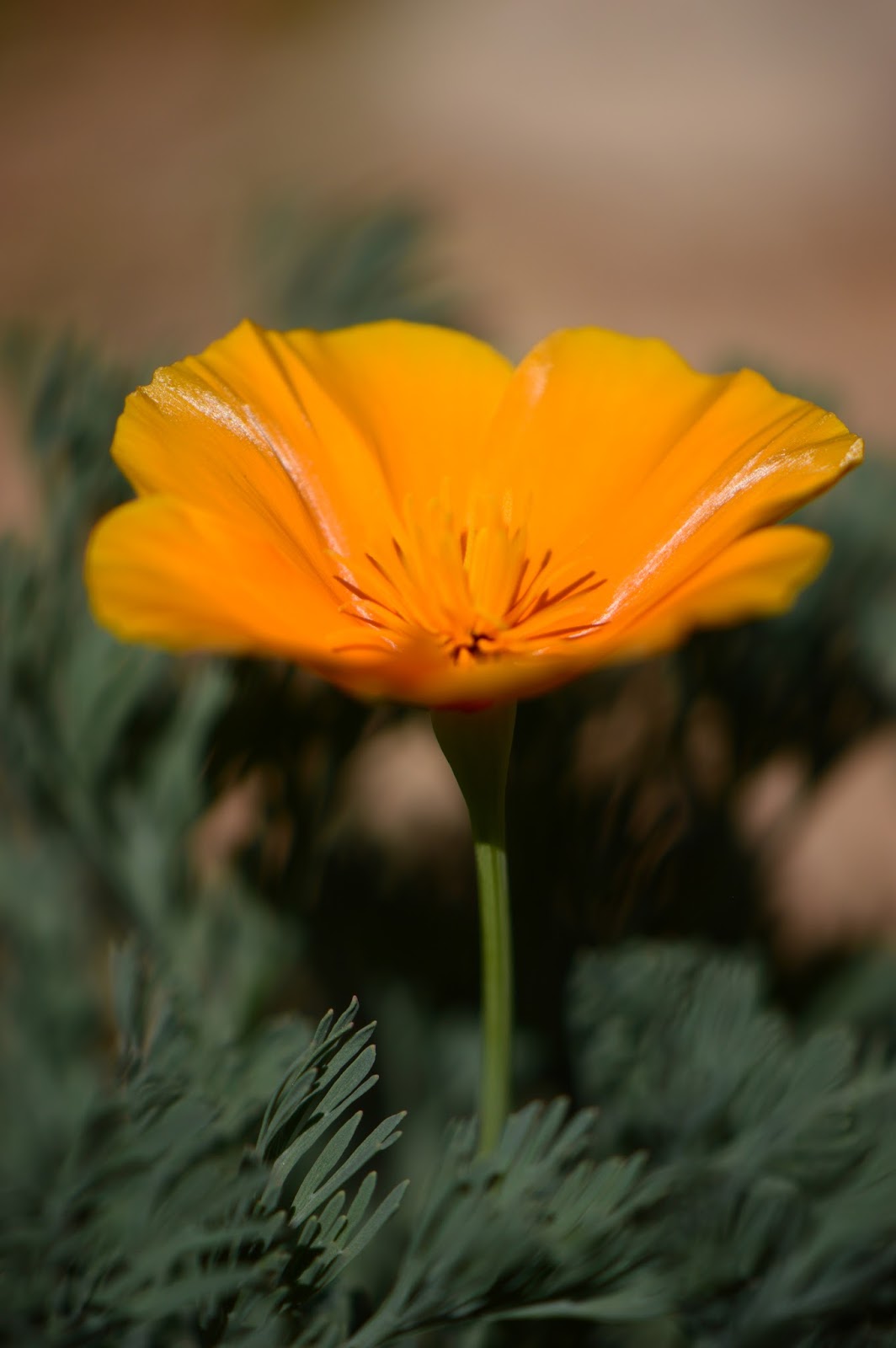
A Touch of Gold

Eschscholzia califonica, California poppy, desert garden, small sunny garden, wildflower, amy myers, photography
Just enjoying the first California poppy to bloom in the garden...
Eschscholzia califonica, California poppy, desert garden, small sunny garden, wildflower, amy myers, photography
This is the simple species Eschscholzia californica, which I felt might have the best chance of growing really well in this garden.  I seeded these back in January, unsure whether it was the correct time for this region.  I felt I had better get the seed down, whether or no, as the packet had accidentally been soaked with water.

Apparently it was the right time, or close enough!
Eschscholzia califonica, California poppy, desert garden, small sunny garden, wildflower, amy myers, photography
These golden beauties are taking over from the species narcissus to keep the East Border bright.

Posting this to join in with the "Favorites" theme with Loree at Danger Garden.
Eschscholzia califonica, California poppy, desert garden, small sunny garden, wildflower, amy myers, photography
Weather Diary: Fair but windy; High: 85 F (29 C)/Low: 51 F (11 C)

Sunday, February 14, 2016

About the Desert Garden, Part 2

small sunny garden, amy myers, sonoran desert
A shady spot just after winter rain
Well, it has taken me a good deal longer than expected to write this post!  In this one I am looking at the immediate environs of the small sunny garden.

There are, of course, many different regions within the Sonoran Desert.  There is considerable variation even across the city of Phoenix.  Our patch (and not a small one!) is influenced by the proximity of the Hassayampa River.

Rivers and aqueducts in the desert are fascinating things with their bright waters flowing through barren plains while herons and other water birds trace their courses overhead.  But the Hassayampa River is not like these, being mostly underground with only short sections of flow perennially on the surface.  Its name, in fact, is said to mean the "Upside-Down River" -- a very apt description!

But for all that, the land here does have the feeling of a river valley, a lowland; and when it rains we don't argue with it, having been stranded in our vehicle overnight during one of the deluges of 2014... about a mile from home, with rushing water blocking the road both behind and in front of us.  It was not a dangerous situation so long as one stayed put, but I must admit it required a good deal of patience!  The waters subside about as quickly as they come, but in rainy seasons there is often significant flooding as the excess waters pass through the many washes that stripe and gully the area.  Rainwater seems to move across the soil much further than it penetrates into it.

A second factor, also important to the garden, is proximity to more mountainous terrain.  This allows our temperatures to be a little lower -- both summer and winter -- than areas closer to the city.  Some freezing nights are to be expected; summertime highs are supposedly not as extreme though still hot enough!  The highest temperature I noticed last summer was 114 F/46 C, and we had two stretches of freezing nights during this last winter.
hassayampa drainage, small sunny garden, sonoran desert
Looking across the nearby ranch at the Vulture Mountains in winter
Quick mountain upthrusts are divided by the flattest of plains.  With this "riverbottom" topography, it is no surprise that much of the soil in these flat lands is fine-grained clay, topped with a rough detritus of gravel and small rock.
soil surface, desert, sonoran desert
 In our nearby washes, this changes to a softer topping of sand or else much heavier rock.

These washes are in turn home to their own tiny ecosystems: little thickets of desert trees and seasonal grasses and wildflowers.  These shift gradually to the creosote and saguaros of the plains, making a varied tapestry across the whole area.

The most common trees in our neighborhood are the mesquite (Prosopis velutina) with its delicate leaves...
prosopis velutina, foliage, mesquite, small sunny garden, amy myers, sonoran desert
...and muted yellow chenille catkins...
small sunny garden, amy myers, sonoran desert, prosopis velutina, bloom
...and the Blue Palo Verde (Parkinsonia floridum), which in spring can be a glory of yellow flowers.  (For more on the nearby Palo Verde, which I have written about through most of 2015 with the Tree Following meme, see here.)
parkinsonia floridum, blue palo verde, bloom, spring, small sunny garden, amy myers, sonoran desert
Both these trees are legumes and provide important food for wildlife from their pods.
parkinsonia floridum, blue palo verde, small sunny garden, amy myers, sonoran desert, seedpods
The low-lying areas tend to host ephemeral flowers and grasses.  There are many different grasses, but they are perhaps best looked at as a specimen plant here, growing in tufts and swathes rather than a solid cover.
small sunny garden, amy myers, sonoran desert, wild grasses
In moist years there is, of course, the marvelous glow of Kallstroemia grandiflora, known as Calltrop or Desert Poppy, but in fact a relative of the Creosote Bush!
kallstroemis grandiflora, calltrop, desert poppy, arizona poppy, desert wildflower, small sunny garden, amy myers, sonoran desert
Probably the most common wildflower in our neighborhood is Globemallow (Sphaeralcea ambigua), which seems to thrive even in drier conditions so long as there is some shade.  Brilliant coral orange (there is some variation) flowers bloom on large, gawky plants with soft, silvery, lobed foliage.  Bloom time follows rain, but these seem to be fairly reliable plants even during drier years.  They are offered as garden perennials, though their size limits placement as they can have a tremendous sprawl!
sphaeralcea ambigua, globemallow, small sunny garden, amy myers, sonoran desert, desert wildflower
And if you watch carefully, there are the tiny bells of Dichelostemma capitatum, a cormous species which sprouts in the most inhospitable places.
small sunny garden, amy myers, sonoran desert, dichelostemma capitatum, blue dicks, desert wildflower
Moving onto even higher ground one finds the iconic saguaro cactus (Carnegiea gigantea), but they are not so frequent here as they are on the rocky hillsides in other parts of the region.  
small sunny garden, amy myers, sonoran desert, carnegiea gigantea, saguaro, cactus, hassayampa drainage
Carnegiea gigantea, with small scattered shrubs of Larrea tridenta (see below) at their feet
Two other cactus species are common locally: the showiest is the Barrel or Fishhook Cactus (Ferrocactus emoryii), with its brilliant red blooms which open just as summer rains begin.
ferrocactus emoryii, barrel, fishhook, small sunny garden, amy myers, sonoran desert
It is not so spectacular the rest of the year, but still worth looking at and walking carefully around!
ferrocactus emoryii, barrel, fishhook, cactus, hassayampa drainage, small sunny garden, amy myers, sonoran desert
At rough estimate, this one is about 3.5 ft (1 m) tall
There are also the Chollas (Opuntia spp.), some of the prickliest of them all.  Unlike the Ferrocactus, these grow happily in the wash in our neighborhood and their pale green blends in with the grasses of the monsoon season.
opuntia, cholla, cactus, hassayampa drainage, small sunny garden, amy myers, sonoran desert
But in this area the most definitive plant is probably the so-called Creosote Bush (Larrea tridentata).  It spreads (in sparse desert fashion) across the empty areas, forming a shrubby green haze that gives an illusion of verdure.  It tends to be spaced widely, and I have read that it exudes a chemical that inhibits growth of nearby plants, though other sources say nothing about this and it seems to be acceptable for garden use.  
creosote, larrea tridentata, small sunny garden, amy myers, sonoran desert
Its fresh, sharp scent fills the air when the weather turns moist.  It grows either low or high, depending on the availability of moisture.  Never (so far as I know) entirely leafless, it puts on a new flush of glossy foliage during wet seasons, then adds some admittedly non-descript yellow blooms...
larrea tridentata, flower, bloom, creosote, small sunny garden, amy myers, sonoran desert
...later accompanied by silver puffballs of seed.
larrea tridentata, creosote, seeds, small sunny garden, amy myers, sonoran desert
  And when nearly bare, its striped branches are fascinating in themselves.
larrea tridentata, creosote, small sunny garden, amy myers, sonoran desert
As can be imagined, where there is a little more water, there will also be animals.  Lizards are plentiful...
small sunny garden, amy myers, sonoran desert, lizard,
...but we also have a plethora of toad species, from various spadefoots (which I think is the type below) to the Colorado River toad, whose poison glands present a serious danger to dogs unwary enough to pester them.  In moist weather in summer, the air is full of the sound of singing toads!  They do a noticably good job of bug control.  (They may also attract rattlesnakes, which I am not looking at in this post, though they are plentiful...)
small sunny garden, amy myers, sonoran desert, toad
Also associated with the presence of water are the dragonflies which occasionally appear.
small sunny garden, amy myers, sonoran desert, dragonfly
Happily, there are also plenty of bees!
bee, ferrocactus, barrel, cactus, flower, small sunny garden, amy myers, sonoran desert
Bee in Ferrocactus flower

 And I had better not start on birds (particularly since there are many common ones for which I have no photos!)  Just a few...
Haemorhous mexicanus, house finch, amy myers, sonoran desert, small sunny garden
House Finch, originally native here though it spread across much of the rest of the country during the last century
Toxostoma curvirostre, curve-billed thrasher, sonoran desert, small sunny garden, amy myers
Curve-billed Thrasher
Calypte anna, annas hummingbird, small sunny garden, sonoran desert, amy myers
Female Anna's Hummingbird in the garden
So that is the lie of the land: a dry lowland across which the rain waters have carved themselves innumerable -- and inalienable -- rights of way.    But those same waters make for a fascinating wealth of plant and animal life.  And as the plants think it is a more hospitable area to grow and bloom, it must be a good choice for a garden!
larrea tridentata, creosote, desert, sonoran, small sunny garden, amy myers