On Friday morning I took a small hike in the empty desert around our home. It began as part of my annual quest to view wild cactus in bloom. We've had a few rainy days and the wild fishhook cacti (Ferocactus sp.; I'm not very confident about identifying wild species and have given this one various names even here on the blog) usually begin to bloom as the monsoon rains provide a bit of moisture. So I headed out, equipped with boots and camera, to check our nearest wild cactus.
So far, one bud has colored up but not opened.
Perhaps I have missed some earlier blooms? This is quite a bit later than they have bloomed the last couple of summers. This year has been very dry with little intermission from high heat, and even our recent rains have been scant. Humidity has risen, but the soil is still quite dry. The cactus is biding its time.
After seeing the cactus, I began paying more attention to what the other wild plants were doing in response to the weather. Here is a look around.
When one thinks of desert plants, the succulents usually come to mind. Cactus and agave plants store water in modified stems and leaves, respectively. But our area is a lowland populated largely by small trees and shrubs (there is not much to distinguish the two as all are bushy and size is mostly a question of available water). With these plants one of the most dramatic ways of coping with intense drought is leaf drop, which reduces moisture loss from leaf surfaces. This year many of the drought-deciduous species are nearly or entirely without leaves.
 |
| Wild Palo Verde growing alongside our street |
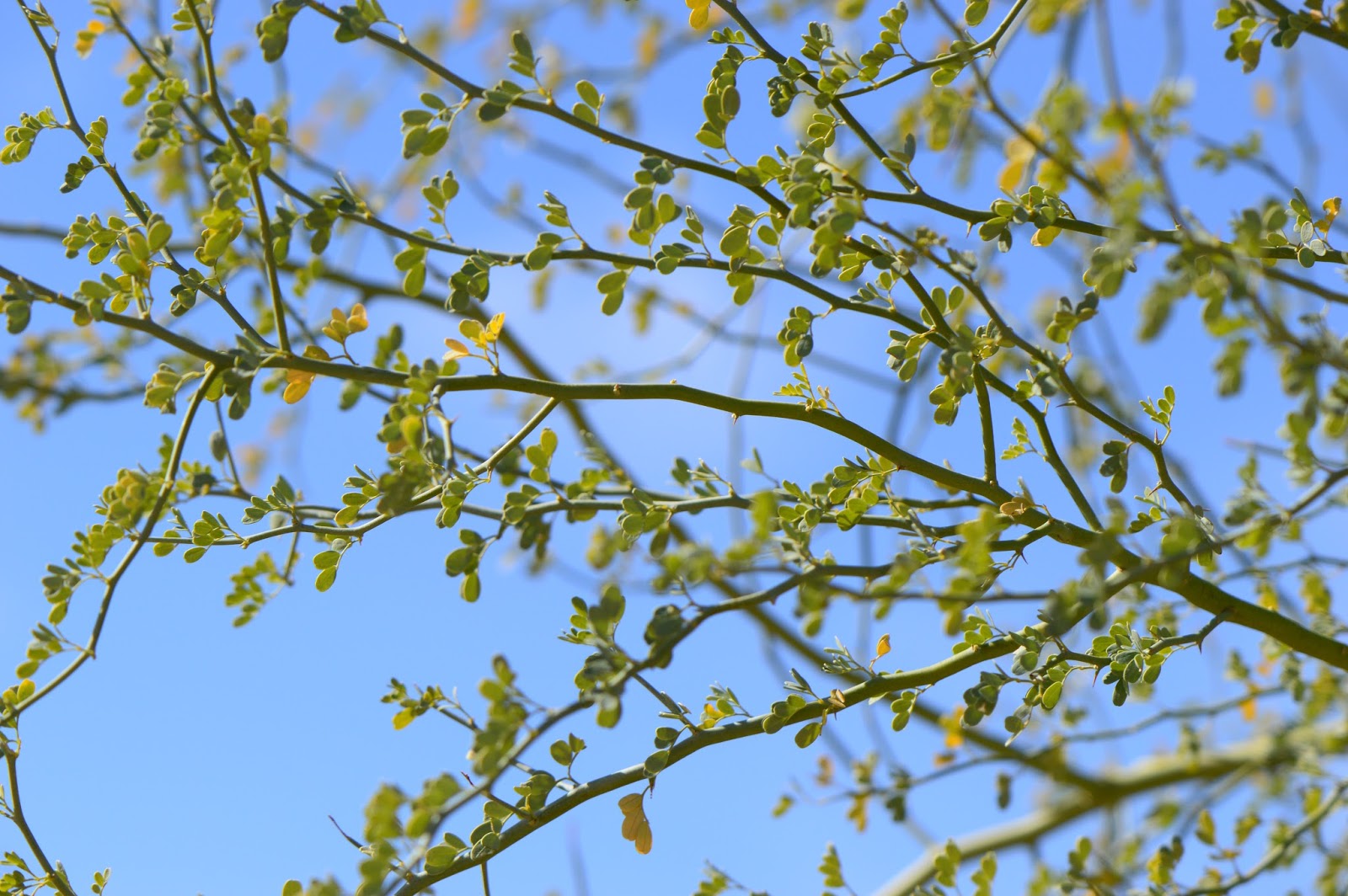
This mechanism is sometimes offset by an ability to conduct photosynthesis through something other than leaves. Here is a branch of Blue Palo Verde (Parkinsonia floridum), whose soft green bark carries on the task through the dry summer months.
Not so with the wolfberry below. Yes, trust me, this plant is alive. It looked like this last summer too! Eventually it will leaf out again and bear its scruffy white flowers and red berries. Again, I don't know what species of Lycium this is; there are at least three or four common in the Sonoran Desert, and I certainly don't know enough to ID it in this condition!
 |
| The very image of "drought-deciduous": Lycium and wild grasses... |
With so few leaves around, the very thorny nature of the desert becomes more evident.
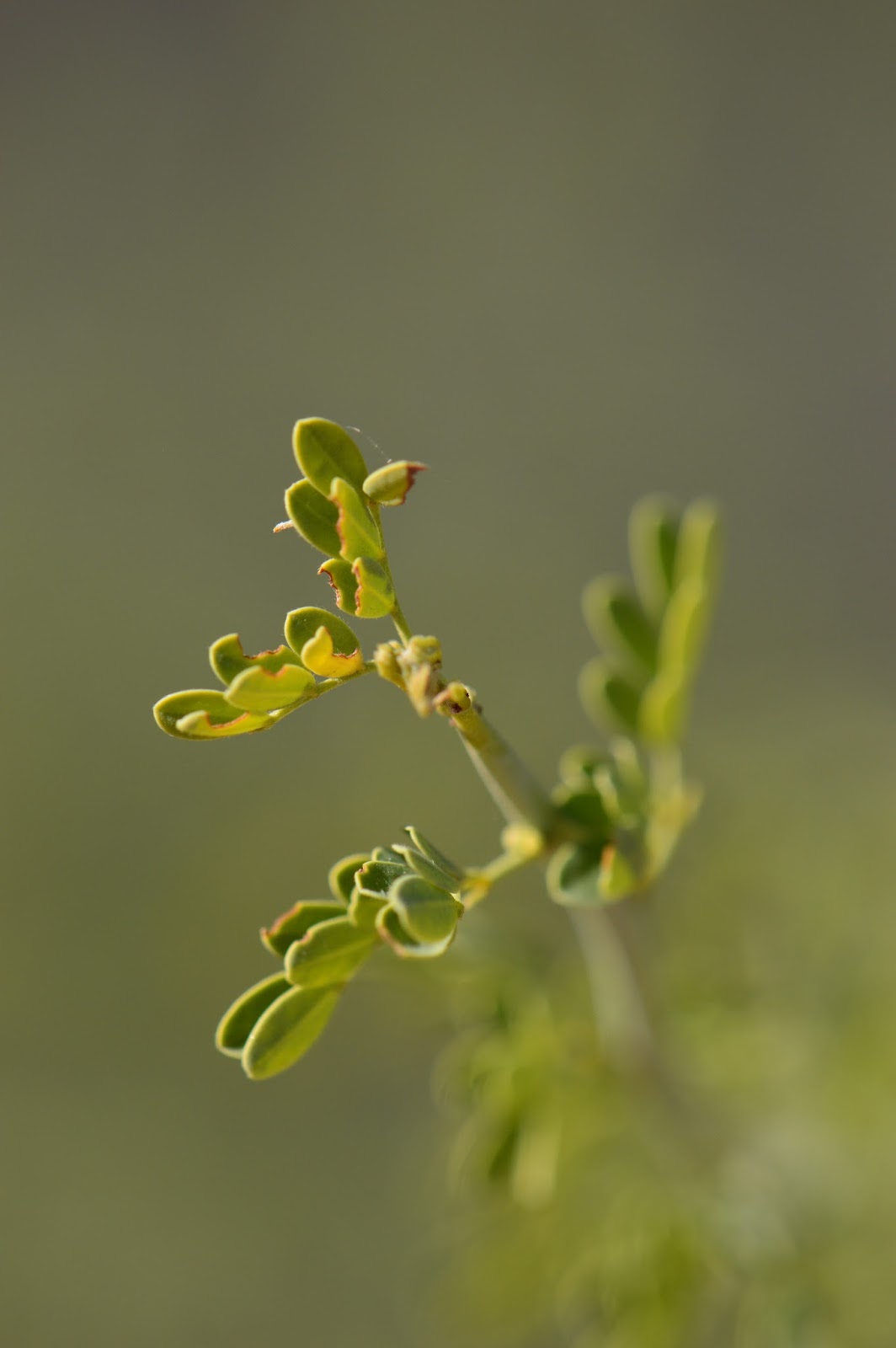
I have no idea what this shrub is, but here one can again see the pale green of the younger branches - and the nasty thorns, protecting a few miniscule leaves.
Other desert plants are much gentler. This is Larrea tridentata (Creosote bush) in its spare, striped, summer elegance.
A few seedpods can be seen dangling from its branches. The rain may yet bring out a light flush of yellow flowers, but I don't see any so far.
The leafiest plants are probably the mesquites (Prosopis velutina). Though they can make sizeable trees, this one grows low and spreading.
It too, has dropped most of its canopy.
Two years ago, in response to record rainfall, the arroyo just beyond was lush, full of grasses and wildflowers. This year the ground is bare, much like the higher ground all around. Here is the view looking back toward our lot.
Most of our rainfall is expected during the winter months. Native plants are well-adapted to dry summers. But monsoon rains are normal, as I keep mentioning to the clouds as they sail over, leaving their precious moisture elsewhere.
Meantime, life in the dry lands goes on.
 |
| Bird's nest in cholla cactus |
For more shots of the very well-protected bird's nest we found down in the arroyo, see my other blog at
Journal of a Thousand Things.
 |
| Larrea tridentata (Creosote bush) |
Weather Diary: Fair; High: 106 F (41 C); Low: 83 F (28 C); Humidity: 20%-56%