|
| A shady spot just after winter rain |
There are, of course, many different regions within the Sonoran Desert. There is considerable variation even across the city of Phoenix. Our patch (and not a small one!) is influenced by the proximity of the Hassayampa River.
Rivers and aqueducts in the desert are fascinating things with their bright waters flowing through barren plains while herons and other water birds trace their courses overhead. But the Hassayampa River is not like these, being mostly underground with only short sections of flow perennially on the surface. Its name, in fact, is said to mean the "Upside-Down River" -- a very apt description!
But for all that, the land here does have the feeling of a river valley, a lowland; and when it rains we don't argue with it, having been stranded in our vehicle overnight during one of the deluges of 2014... about a mile from home, with rushing water blocking the road both behind and in front of us. It was not a dangerous situation so long as one stayed put, but I must admit it required a good deal of patience! The waters subside about as quickly as they come, but in rainy seasons there is often significant flooding as the excess waters pass through the many washes that stripe and gully the area. Rainwater seems to move across the soil much further than it penetrates into it.
A second factor, also important to the garden, is proximity to more mountainous terrain. This allows our temperatures to be a little lower -- both summer and winter -- than areas closer to the city. Some freezing nights are to be expected; summertime highs are supposedly not as extreme though still hot enough! The highest temperature I noticed last summer was 114 F/46 C, and we had two stretches of freezing nights during this last winter.
 |
| Looking across the nearby ranch at the Vulture Mountains in winter |

These washes are in turn home to their own tiny ecosystems: little thickets of desert trees and seasonal grasses and wildflowers. These shift gradually to the creosote and saguaros of the plains, making a varied tapestry across the whole area.
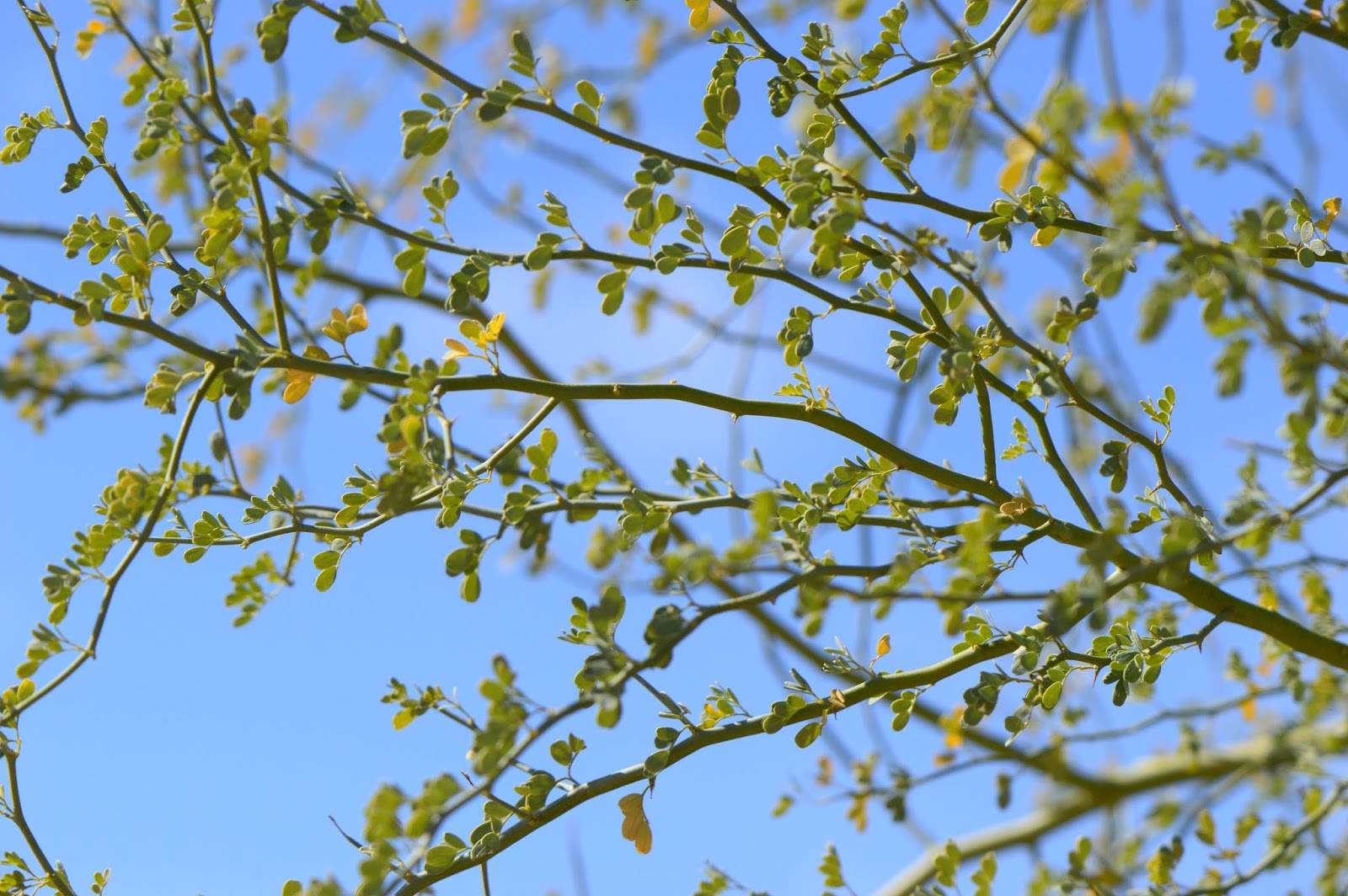
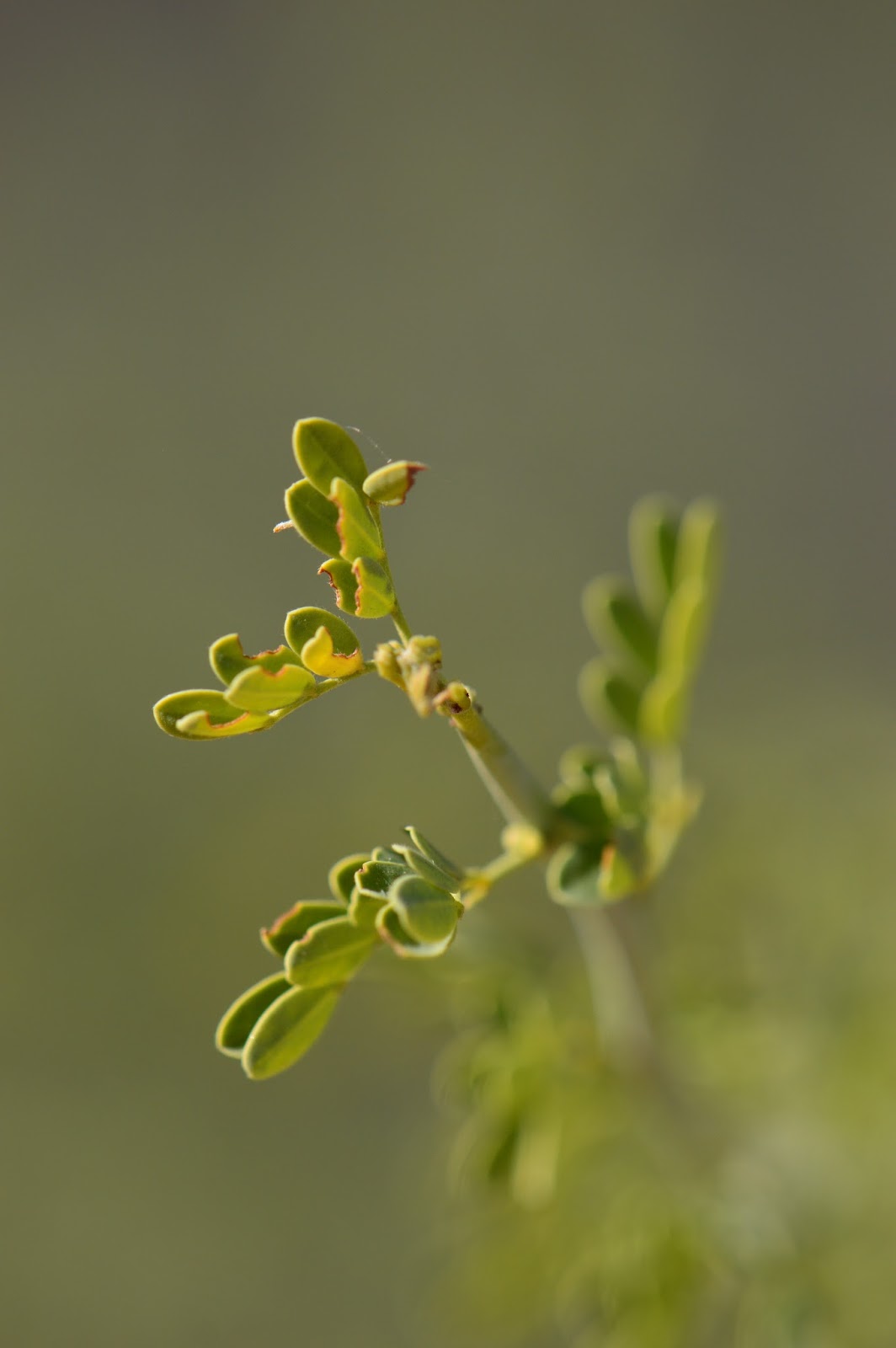
The most common trees in our neighborhood are the mesquite (Prosopis velutina) with its delicate leaves...


The low-lying areas tend to host ephemeral flowers and grasses. There are many different grasses, but they are perhaps best looked at as a specimen plant here, growing in tufts and swathes rather than a solid cover.

In moist years there is, of course, the marvelous glow of Kallstroemia grandiflora, known as Calltrop or Desert Poppy, but in fact a relative of the Creosote Bush!

Probably the most common wildflower in our neighborhood is Globemallow (Sphaeralcea ambigua), which seems to thrive even in drier conditions so long as there is some shade. Brilliant coral orange (there is some variation) flowers bloom on large, gawky plants with soft, silvery, lobed foliage. Bloom time follows rain, but these seem to be fairly reliable plants even during drier years. They are offered as garden perennials, though their size limits placement as they can have a tremendous sprawl!

And if you watch carefully, there are the tiny bells of Dichelostemma capitatum, a cormous species which sprouts in the most inhospitable places.

Moving onto even higher ground one finds the iconic saguaro cactus (Carnegiea gigantea), but they are not so frequent here as they are on the rocky hillsides in other parts of the region.
 |
| Carnegiea gigantea, with small scattered shrubs of Larrea tridenta (see below) at their feet |
Two other cactus species are common locally: the showiest is the Barrel or Fishhook Cactus (Ferrocactus emoryii), with its brilliant red blooms which open just as summer rains begin.

It is not so spectacular the rest of the year, but still worth looking at and walking carefully around!
 |
| At rough estimate, this one is about 3.5 ft (1 m) tall |
There are also the Chollas (Opuntia spp.), some of the prickliest of them all. Unlike the Ferrocactus, these grow happily in the wash in our neighborhood and their pale green blends in with the grasses of the monsoon season.

But in this area the most definitive plant is probably the so-called Creosote Bush (Larrea tridentata). It spreads (in sparse desert fashion) across the empty areas, forming a shrubby green haze that gives an illusion of verdure. It tends to be spaced widely, and I have read that it exudes a chemical that inhibits growth of nearby plants, though other sources say nothing about this and it seems to be acceptable for garden use.

Its fresh, sharp scent fills the air when the weather turns moist. It grows either low or high, depending on the availability of moisture. Never (so far as I know) entirely leafless, it puts on a new flush of glossy foliage during wet seasons, then adds some admittedly non-descript yellow blooms...


...but we also have a plethora of toad species, from various spadefoots (which I think is the type below) to the Colorado River toad, whose poison glands present a serious danger to dogs unwary enough to pester them. In moist weather in summer, the air is full of the sound of singing toads! They do a noticably good job of bug control. (They may also attract rattlesnakes, which I am not looking at in this post, though they are plentiful...)


 |
| Bee in Ferrocactus flower |
 |
| House Finch, originally native here though it spread across much of the rest of the country during the last century |
 |
| Curve-billed Thrasher |
 |
| Female Anna's Hummingbird in the garden |