Today's vase had to be put together quickly, and tonight's post the same. Please forgive the brevity!
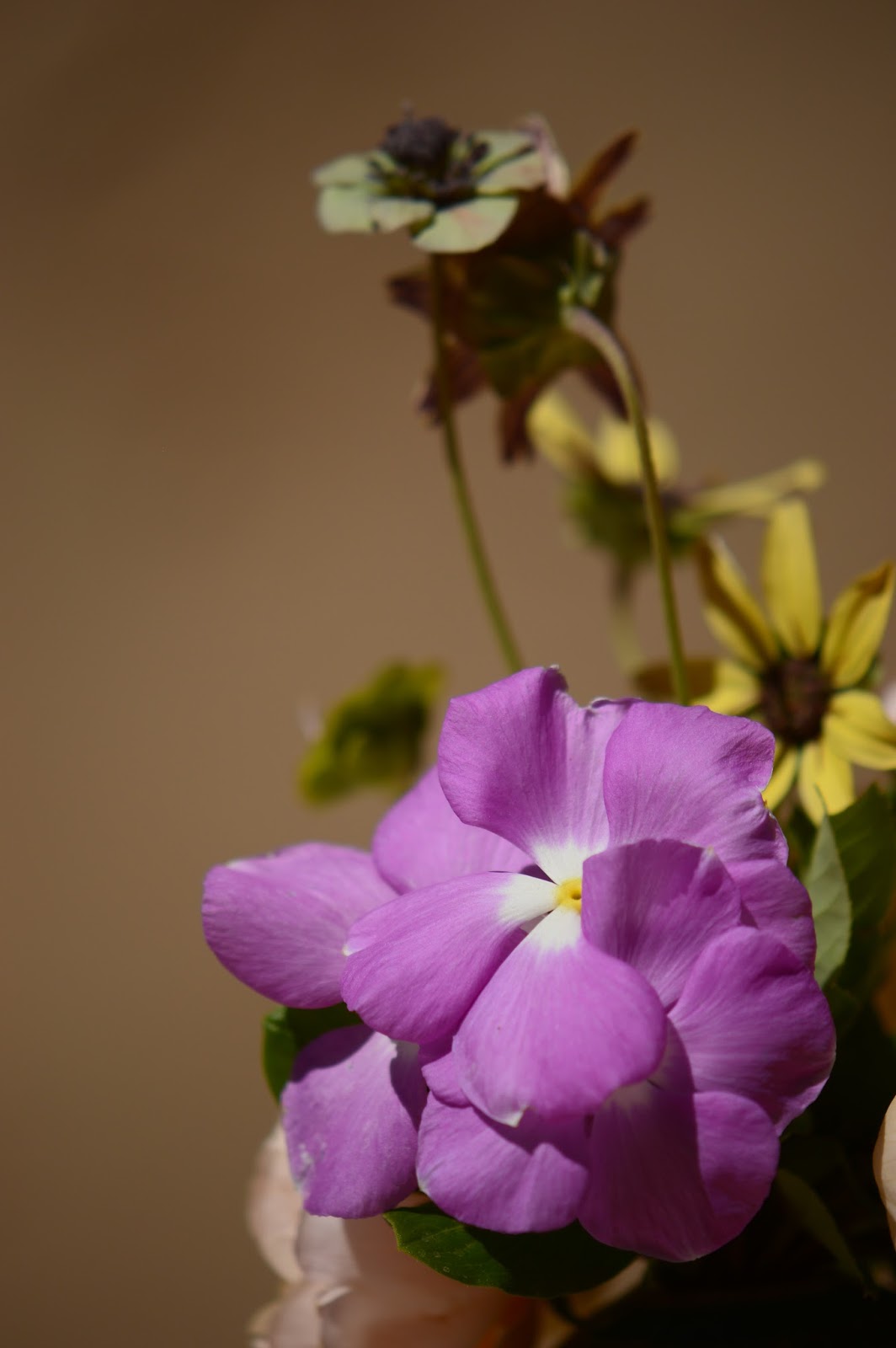
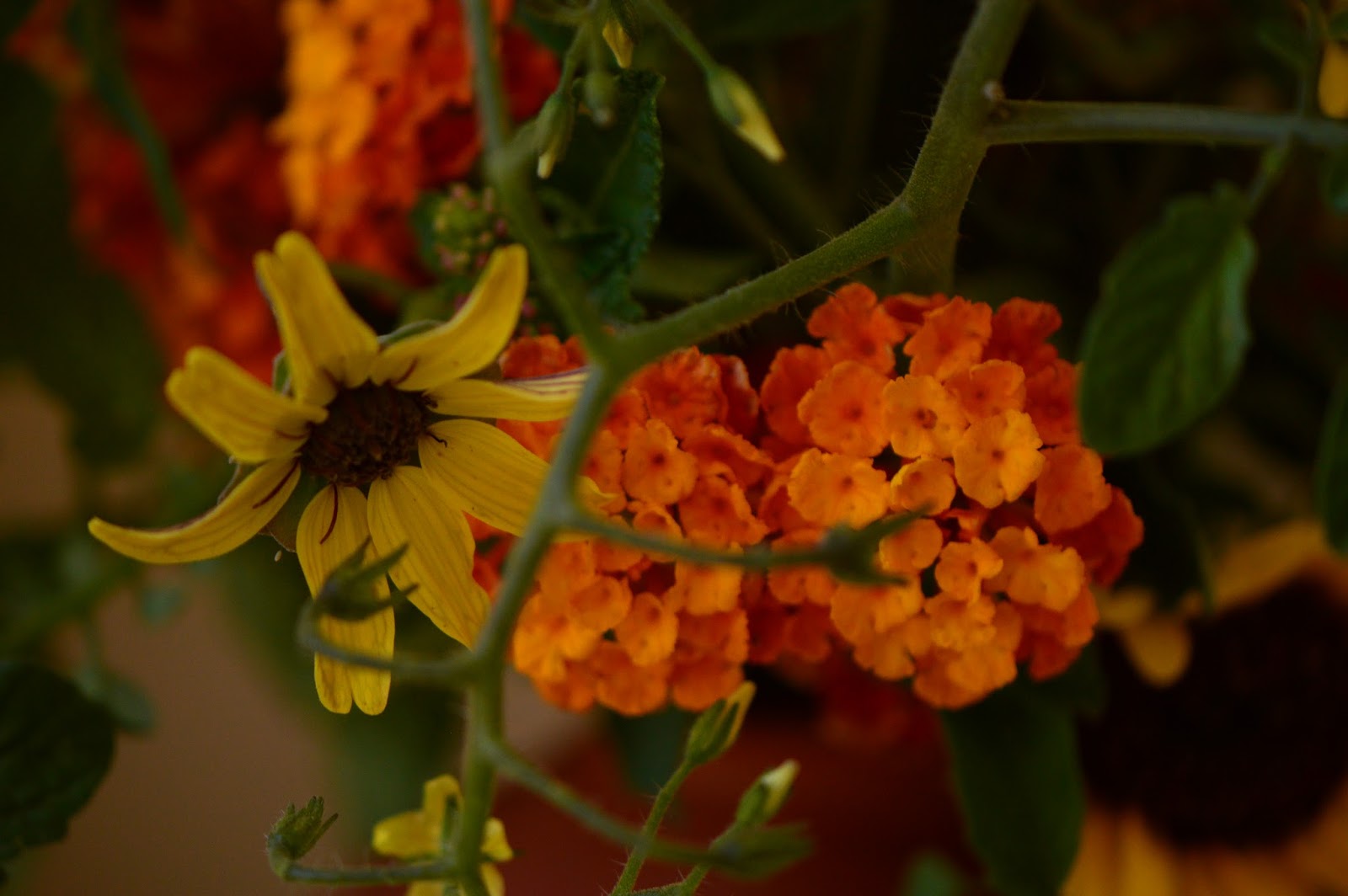
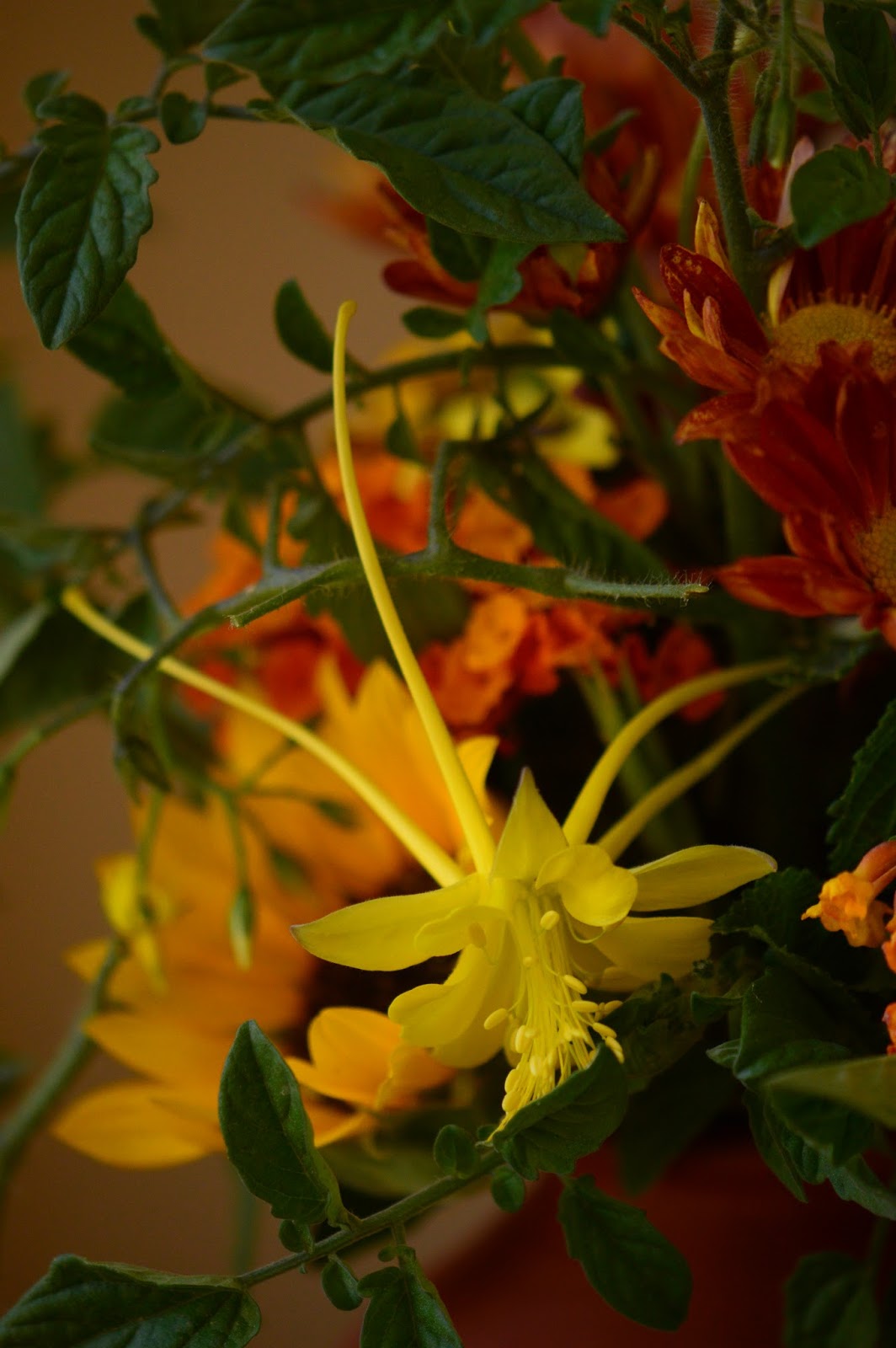
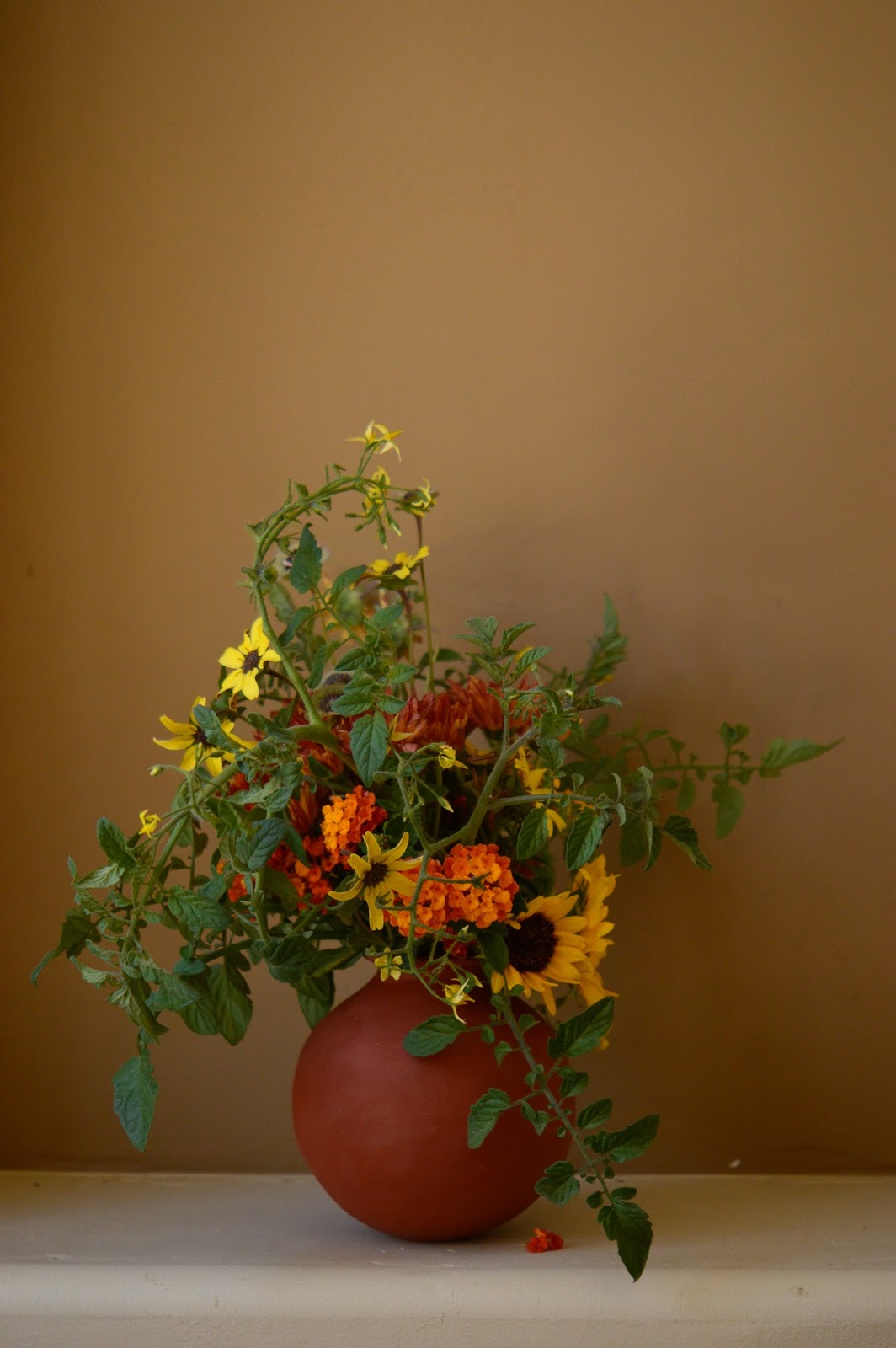
Rose "Wollerton Old Hall", Catharanthus roseus, and Berlandiera lyrata make an impromptu combination in one of my stoneware jars.
The Berlandiera was a bit of an experiment, with flowers picked after they had already closed for the day, in hopes they would reopen inside. They did, perhaps slightly the worse for wear; but nevertheless they make a good addition to the vase.
As I mentioned in my recent post on Berlandiera, the blooms have a curious way of retaining their sepals and centers after the petals drop, with an effect still fairly decorative.
I was pleased to find that some stems on the Catharanthus are now long enough to allow me to cut the flowers.
Today's vase is certainly in the rapidly plonked style, but it still gives a great deal of enjoyment! I photographed it outside, resting on a bit of broken marble tile.
It is special to have all these flowers available in mid-June. The garden is far ahead of where it was this time last year, and so far it is handling summer's heat well. I have a few dried flowers back for lean times but, happily, I have not had to use them so far!
Do check the other vases inspired by the Monday Vase meme at Rambling in the Garden, which has encouraged so many of us to bring a bit of the garden indoors!
Weather Diary: Fair; High: 97 F (36 C)/ Low: 74 F (23 C); Humidity: 7%-24%
A small garden in the English style, set in the wilds of the northern Sonora Desert...
Showing posts with label berlandiera. Show all posts
Tuesday, June 14, 2016
Thursday, June 9, 2016
The Plants: Berlandiera Lyrata
So who can resist a flower that smells like chocolate...? A sweet scent, vaguely like a chocolate bar, wafting around the garden on a warm morning breeze...
I planted Berlandiera lyrata for many reasons, and it has proved a stellar plant in my garden, far beyond the charm of the unusual fragrance. It is tolerant of low-desert heat as well as a good deal of cold, said to be hardy to -15 F/-26 C. Although I watered it frequently during its first summer, this summer it is thriving on widely spaced, deep waterings.
The rayed blooms are a creamy golden yellow, centered with burgundy.
The petal backs have a tracery of burgundy as well. When they fall, the central discs remain attractive for some time, framed with the still-green sepals. Leaves are gray-green, long and slender, with scalloped edges. Although the width is normally given at around 2 ft/.6 m, mine has spread further in its two years, still remaining about 18 in/.5 m tall. Overall habit is sprawling, but dense enough to keep it attractive.
During spring the flowers remain open all day, but as sunlight becomes more direct they close early in the morning. This may not occur in more temperate gardens! Despite this, the plant is capable of continuing to bloom through very difficult weather, including dry June in the Sonoran Desert.
It is native across a wide region from extreme southwestern Kansas across to Arizona and into Mexico. This means it is well adapted to dry conditions but can tolerate some moisture though it may get lanky with additional water. It takes alkaline soils in its stride. So far as I know, only the species is available. It is said to start easily from seed as well, though I purchased mine as a young (and quite scraggly) nursery plant.
Now that it has filled out, it makes a wonderful carpet beneath Acacia salicina, with some stems actually clambering up into the nearby shrub Senna nemophila. Clearly Berlandiera has a good many possibilities in a garden!
This is the second post in my small encyclopedia of plants for the desert garden. A brief entry is included also on the encyclopedia page (see top of post).
As I have just discovered the wonderful Thursdays Feature at Cosmos and Cleome I am also linking this post there, where a number of other special plants can be discovered! Ed. Unfortunately, apparently I am not linking there; once again I am unable to post on a WordPress blog, this time despite my recent flirtation with Gravatar!
Weather Diary: Sunny; High: 104 F (40 C)/Low: 82 F (28 C); Humidity: 16-40%
I planted Berlandiera lyrata for many reasons, and it has proved a stellar plant in my garden, far beyond the charm of the unusual fragrance. It is tolerant of low-desert heat as well as a good deal of cold, said to be hardy to -15 F/-26 C. Although I watered it frequently during its first summer, this summer it is thriving on widely spaced, deep waterings.
The rayed blooms are a creamy golden yellow, centered with burgundy.
The petal backs have a tracery of burgundy as well. When they fall, the central discs remain attractive for some time, framed with the still-green sepals. Leaves are gray-green, long and slender, with scalloped edges. Although the width is normally given at around 2 ft/.6 m, mine has spread further in its two years, still remaining about 18 in/.5 m tall. Overall habit is sprawling, but dense enough to keep it attractive.
It is native across a wide region from extreme southwestern Kansas across to Arizona and into Mexico. This means it is well adapted to dry conditions but can tolerate some moisture though it may get lanky with additional water. It takes alkaline soils in its stride. So far as I know, only the species is available. It is said to start easily from seed as well, though I purchased mine as a young (and quite scraggly) nursery plant.
Now that it has filled out, it makes a wonderful carpet beneath Acacia salicina, with some stems actually clambering up into the nearby shrub Senna nemophila. Clearly Berlandiera has a good many possibilities in a garden!
This is the second post in my small encyclopedia of plants for the desert garden. A brief entry is included also on the encyclopedia page (see top of post).
As I have just discovered the wonderful Thursdays Feature at Cosmos and Cleome I am also linking this post there, where a number of other special plants can be discovered! Ed. Unfortunately, apparently I am not linking there; once again I am unable to post on a WordPress blog, this time despite my recent flirtation with Gravatar!
Weather Diary: Sunny; High: 104 F (40 C)/Low: 82 F (28 C); Humidity: 16-40%
Monday, May 9, 2016
In a Vase: Sunshine in a Vase
Heading into summer, I had a lot of material availabe to use in a vase today. I had already decided to use some of the secondary blooms from the sunflowers, which are beginning to go to seed. So it made sense to select some other flowers from the same color range.
There is lantana...
...and plenty of Berlandiera lyrata, the wonderful chocolate flower. Fortunately for vasemaking, it remains open in indoor light, despite a tendency to close under extremely high midday sun.
There are chrysanthemums from my impulse buy last fall, which decided to go on a blooming spree.
There is a single bloom of Aquilegia chrysantha "Swallowtail"...
...and a small sprig of Tagetes lucida aka Mexican tarragon. I would have used more, but the plant is not large enough yet.
But I suppose the most astonishing addition is foliage and flowers from my tomato vine.
I intend to write a post about the tremendous tomato soon. Suffice to say, it needed trimming back to allow me to walk along my garden paths. I felt a few stems could come indoors for today's vase, to which it adds a nice airy effect from the flowers and a tousled look from the many-angled leaves. Initially it wilted down but then perked up again when settled in the vase.
As you can see, it was quite a mix of flowers!
I used one of my recent handbuilt vases (coiled, not thrown), this one in a dark earthenware clay.
And now I need to start my next batch of sunflower seeds for late season bloom...
Meantime, it's Monday, so I'm linking with the wonderful IaVoM at Rambling in the Garden!
Weather Diary: Sunny; High: 84 F (29 C)/Low: 58 F (14 C)
Friday, March 18, 2016
Garden Bloom in March
It's such a perfect time of year here: longer days, pleasantly warm temperatures, cool breezes, and of course plenty of sunshine. The garden is responding in kind and is packed with bloom, so much so that I keep finding myself taking a mental inventory as to what will be left to flower later in the year! A very good state of spring bloom and far beyond where the garden was last March.
Of course, I have added a good many plants during the intervening months. I have also focused more on learning to use annuals through the cooler months here, and the results are fairly good so far.
I am not going to give a complete overview for GBBD this March. I would rather look at some specific elements that are making a big difference in filling out the garden just now. And I will note the more seasonal bloomers for this time of year.
Violas are more or less indispensable, but they do seem to be struggling with the temperatures already. I blame this partly on a much drier winter than the one before.
Recently into bloom is Cerinthe major "purpurescens". This is the first time I have grown it, and I want to thank those of you who encouraged me to try it! Its foliage alone is worth a good spot in the garden, and the almost iridescent purple of the bracts is wonderful.
The sweet peas are yet to bloom, though so close that I expect to see some colour any day now.
Finally, there are the pelargoniums. In a mild winter climate such as coastal California, these are perennial and shrub-like. I am sure they would be the same here, except their capacity to survive full desert summer is limited, and I've been advised to either treat them as autumn/winter/spring annuals, or else lift them (or take cuttings) and bring them indoors for the summer! I may try the latter idea if I have the energy... I have three now, the classic scarlet pictured, plus a salmon-coloured one and my lovely ivy-leaf, which is already in a container on the patio. I had planted it in the Central Bed, where the foliage promptly bleached in the sunlight (not full sun either, I might add!), so I dug it and plonked it in with my potted basil, where it now thrives with a roof over its head all day long. At least it left me in no doubt what it wanted!
...and from Ruellia brittonia.
Not newcomers, but important in the spring garden, are Senna nemophila, whose yellow blooms have nearly all gone to seed pods now...
...while Cytisus x spachianus is just beginning to flower.
I did not really care for the Cytisus properly last year because partway through summer I abandoned hope of its survival. It suffered seriously from chlorosis and perhaps some leaf burn as well. But come cooler weather, it recovered nicely. So I am once again enjoying the wonderful fragrance of the bright flowers, and I am hoping to somehow coax it through summer's heat in better condition this year. It is lush green and loaded with buds now, so deserves a bit of pampering, I suppose!
The last flowering shrub for today's post is Leucophyllum frutescens (probably "Green Cloud", not "Compacta" as I had earlier thought). While this can flower at almost any time of year, it is worth noting that it has greened up well after looking wan and worn in late winter. A sudden small burst of bloom is a wonderful bonus.
Two of the L. stoechas varieties are "Madrid" and "Blueberry Ruffles". The former has so far been much the more vigorous, but as BR finally comes into its own, I can admire the slightly bluer hues of the "ears". It is looking good now, and I am glad I did not toss it out last year as I repeatedly thought of doing! It is still a smaller, looser plant than "Madrid", but that is fine.
The other Spanish lavender is an unknown variety kindly given from my cousin's garden. Neither she nor I remember what the original plant is, but the little fly-away tops seem to at least identify it as L. stoechas. It came with me to Arizona two and a half years ago, but I made the mistake of planting it in our front patio planter, where it was too stressed to flower. Last autumn I moved it to the new North Border, where it is finally settling down.
Then there is "Goodwin's Creek Gray", totally different in foliage and bloom. The former is much longer, wider and intensely silver. Flower heads are long and slender. A magnificent lavender. Flowers are getting a little sparse now as blooming has been going on for months, unlike the Spanish varieties, which are just coming into flower.
Another Salvia, a new one, is blue-flowering S. farinacea. We have gotten as far as buds.
Berlandiera lyrata is in bloom now as well. Last year it continued through much of the summer.
And Tetraneuris acaulis deserves special mention. Rarely entirely without flowers, it now is covered in bloom. Such an enormous show for such a tiny plant!
It is a beautiful plant that demands a minimum of care and water, even here. I give it an occasional long soaking and feed it very lightly.
The second Penstemon is P. pseudospectabilis, planted last autumn. It seems to have the same rugged constitution. Its flowers are a warm magenta, lacking the bearded throat. Its foliage is fascinating: blue-hued circular leaves that in some cases wrap entirely around the stems. It is seen here against a backdrop of Dianthus flowers.
Another seasonal bloomer is Anigozanthos flavidus, the Kangaroo Paws. I have grown it in a container and tried to ensure excellent drainage, apparently critical for these plants. More recently I have read that they are not particularly drought-tolerant, which probably explains the loss of the one I planted in the East Border last spring. But my remaining plant is growing enthusiastically, and I have hopes of dividing it this coming autumn and once more testing it directly in the garden.
The freesias are fading; and Narcissus x odorus and N. "Nir", the paperwhite, have just finished for the year. But Tulipa saxatalis, often recommended for regions with no winter chill, has just opened its first flower.
Two very special appearances in the garden come from Hippeastrum "Ambiance"...
...and, much more furtively, from Dichelostemma capitatum, the wildflower transplanted from the west corner of the property into the Central Bed, where it winds its way through The Alnwick Rose.
And Dutch Iris "Blue Magic" is opening now as well. It looks like more of the bulbs will flower this year than last, when I was disappointed at the number of irises that came up blind. I am still not sure why this happens with so many of the standard bulbs here. I would attribute it to lack of winter chill; but I know this cannot be the case with Dutch Iris, which are successfully grown by my cousin in southern California, where they receive less chill than here.
Of course, I have added a good many plants during the intervening months. I have also focused more on learning to use annuals through the cooler months here, and the results are fairly good so far.
I am not going to give a complete overview for GBBD this March. I would rather look at some specific elements that are making a big difference in filling out the garden just now. And I will note the more seasonal bloomers for this time of year.
Annuals
First, a look at the annuals. Dianthus has been in bloom ever since I purchased a six-pack last autumn. Only six plants, but what a difference they have made, accenting the lower corners of the Central Bed! They are thick and bushy now. The photo certainly does not do them justice, but it gives a hint of how nicely they combine, in this case with Penstemon pseudospectabilis, of which more later!Violas are more or less indispensable, but they do seem to be struggling with the temperatures already. I blame this partly on a much drier winter than the one before.
Recently into bloom is Cerinthe major "purpurescens". This is the first time I have grown it, and I want to thank those of you who encouraged me to try it! Its foliage alone is worth a good spot in the garden, and the almost iridescent purple of the bracts is wonderful.
The sweet peas are yet to bloom, though so close that I expect to see some colour any day now.
Shrubs
At the other end of the spectrum, structurally speaking, are the shrubs. I have added some new ones over the last few months and am enjoying bloom from Alyogyne huegelii, the so-called Blue Hibiscus......and from Ruellia brittonia.
Not newcomers, but important in the spring garden, are Senna nemophila, whose yellow blooms have nearly all gone to seed pods now...
...while Cytisus x spachianus is just beginning to flower.
I did not really care for the Cytisus properly last year because partway through summer I abandoned hope of its survival. It suffered seriously from chlorosis and perhaps some leaf burn as well. But come cooler weather, it recovered nicely. So I am once again enjoying the wonderful fragrance of the bright flowers, and I am hoping to somehow coax it through summer's heat in better condition this year. It is lush green and loaded with buds now, so deserves a bit of pampering, I suppose!
The last flowering shrub for today's post is Leucophyllum frutescens (probably "Green Cloud", not "Compacta" as I had earlier thought). While this can flower at almost any time of year, it is worth noting that it has greened up well after looking wan and worn in late winter. A sudden small burst of bloom is a wonderful bonus.
Lavender
For the first time, all my lavenders are blooming simultaneously. Three Lavendula stoechas varieties and the dentata hybrid "Goodwin's Creek Gray" are proving how well suited lavenders can be to desert growing. This was something I had promised myself for this garden: a whole lot of lavender and collecting various kinds. The first goal I have begun, but the latter has proven more elusive and I must try a bit harder!Two of the L. stoechas varieties are "Madrid" and "Blueberry Ruffles". The former has so far been much the more vigorous, but as BR finally comes into its own, I can admire the slightly bluer hues of the "ears". It is looking good now, and I am glad I did not toss it out last year as I repeatedly thought of doing! It is still a smaller, looser plant than "Madrid", but that is fine.
| Lavendula stoechas "Blueberry Ruffles" |
| Close-up of the tuft on top |
| Lavender "Goodwin's Creek Gray" |
Perennials
Salvia greggii varieties tend to bloom nearly year-round here; and I would not mention them in this post, except that I must gloat over "Autumn Moon". A vigorous but gradual cutting back has returned it to its former glory, much of which had faded into a non-descript mass of flopping stems, yellowish foliage and stunted flowers. So much so that I took some cuttings in an attempt to ensure I didn't lose the variety, which I have not seen available since I purchased this plant. But the parent plant has certainly come back into its own! Amusingly, this dainty cream and pink variety is favored by our female hummingbird, while the crimson "Flame" (also blooming well) is preferred by the male.Another Salvia, a new one, is blue-flowering S. farinacea. We have gotten as far as buds.
Berlandiera lyrata is in bloom now as well. Last year it continued through much of the summer.
And Tetraneuris acaulis deserves special mention. Rarely entirely without flowers, it now is covered in bloom. Such an enormous show for such a tiny plant!
Another plant in full stride is Oenothera pallida "Innocence" and its seedlings. Like other Oenotheras, it does self-seed; besides which, it has grown quite large, perhaps 24 to 36 inches high and wide (about .7 to 1 m). I intend to begin transferring seedlings to the white garden, where its vigorous habit will be a definite advantage. For now, I am enjoying its large pure white flowers and delicious fragrance while trying to keep it from smothering nearby plants.
Penstemons
And it would not be spring here without the desert native penstemons. P. parryi has grown taller this year and bloomed even more heavily than last. The hummingbirds love it, but I have not had much luck getting pictures of them on it. This is about the best so far.It is a beautiful plant that demands a minimum of care and water, even here. I give it an occasional long soaking and feed it very lightly.
The second Penstemon is P. pseudospectabilis, planted last autumn. It seems to have the same rugged constitution. Its flowers are a warm magenta, lacking the bearded throat. Its foliage is fascinating: blue-hued circular leaves that in some cases wrap entirely around the stems. It is seen here against a backdrop of Dianthus flowers.
Another seasonal bloomer is Anigozanthos flavidus, the Kangaroo Paws. I have grown it in a container and tried to ensure excellent drainage, apparently critical for these plants. More recently I have read that they are not particularly drought-tolerant, which probably explains the loss of the one I planted in the East Border last spring. But my remaining plant is growing enthusiastically, and I have hopes of dividing it this coming autumn and once more testing it directly in the garden.
Bulbs, Corms, and Such
Finally, spring is the season for flowering bulbs and their kin. The best showing at the moment still comes from Ranunculus.The freesias are fading; and Narcissus x odorus and N. "Nir", the paperwhite, have just finished for the year. But Tulipa saxatalis, often recommended for regions with no winter chill, has just opened its first flower.
Two very special appearances in the garden come from Hippeastrum "Ambiance"...
...and, much more furtively, from Dichelostemma capitatum, the wildflower transplanted from the west corner of the property into the Central Bed, where it winds its way through The Alnwick Rose.
And Dutch Iris "Blue Magic" is opening now as well. It looks like more of the bulbs will flower this year than last, when I was disappointed at the number of irises that came up blind. I am still not sure why this happens with so many of the standard bulbs here. I would attribute it to lack of winter chill; but I know this cannot be the case with Dutch Iris, which are successfully grown by my cousin in southern California, where they receive less chill than here.
Well, I am finishing this post days after I began it. I've been busy with this and that -- including the garden -- and unable to complete this Garden Bloggers' Bloom Day post till now. Of course, in the meantime, a number of new plants have bloomed so I have been going around with the camera playing catch-up! However, the post is going up now with a minimum of new photos (only the Hippeastrum, really) since this is supposed to represent what was actually blooming on the 15th of the month. Time flies!
And, happily, rose "Graham Thomas" had already sent out its first bloom of the year!
Weather Diary: Sunny and fair; High: 88 F (31 C)/Low: 50 F (10 C)
Labels:
Anigozanthos,
berlandiera,
Cerinthe,
Cytisus,
Dichelostemma,
GBBD,
Hippeastrum,
Iris Blue Magic,
Lavender,
Leucophyllum,
Oenothera,
Penstemon,
Ranunculus,
Ruellia,
Salvia farinacea,
Salvia greggii,
tetraneuris,
Tulip
Subscribe to:
Posts (Atom)