Showing posts with label Senecio "Blue Fingers". Show all posts

Thursday, April 30, 2015

The Dry Corner in April

Anigozanthos "Bush Ranger"
A small burst of bloom from the Kangaroo Paws - Anigozanthos "Bush Ranger" - is a wonderful touch for this month's End of Month View from the garden.  I missed last month, but in February I began focusing this theme on the Dry Corner.

The Dry Corner is a patch at the entrance/exit to the garden, the point at which one walks out into the big world (generally headed straight to the horse corrals).  As it is furthest from the shade of the patio, I decided to make it the area where I used the most obviously xeric plants.  This gives it a little different character than the rest of the garden, but also allows me to trial some wonderful species in an area reserved for their preferences.

I have developed the garden more or less from the edge of the patio downward (the west edge of the garden), though gaps exist throughout.  So the east border, with the Dry Corner at one end, is one of the least fully planted areas.  Featuring it for the end of the month view has changed that a little.  I have gone ahead and added a few plants over the last couple of months.  Here we are now...
It all looks very sparse still!  But additions include Crassula "Campfire" in the foreground (foliage is colouring up nicely now it is in full sun)...
Crassula "Campfire"
and a second Anigozanthos behind it - just a clump of rather dubious foliage at present; this was one of my recent purchases from the discount shelf so no picture available yet!  To the far left is Senna nemophila.  This young Australian shrub gave a few of its yellow blooms in early spring.  The showing was rather brief, followed by one lone seedpod, since removed.  It has not settled in as easily as I hoped.  It is always a rather scantily clad bush, with its lovely narrow leaves forming a haze of pale green.  However, there is quite a bit of yellowing of leaves, and some leaf drop.  I don't know why at this point since this is said to be a well-adapted plant for the region.  The second picture is from early March, when the few blooms appeared.
Senna nemophila flower
It grows just below the anchor of the Corner, which is the more or less weeping Acacia salicina.  It has put out quite a bit of new growth this spring and is now officially taller than I am though its head droops such that the increase in height is not terribly obvious.  But it is looking healthy and happy.  It is hard to photograph as the stake bracing it is so much heftier than the tree itself.  Here is a close-up of the leaves, at any rate!
Acacia salicina
Another new plant is Lampranthus vygie "Lilac Mist" (I think that is the name - it's too late at night to go check!) just on the edge of the panorama view above.  It had plenty of flowers - hot pink rays and yellow centres - when I bought it, but they collapsed upon planting.  Foliage is blue-green and rather attractive.  I say this despite the fact that somehow I developed a rather negative attitude towards ice plant varieties generally - a silly attitude given their usefulness in extremely difficult garden situations!  Perhaps growing this one will encourage a more positive view of them.
Lampranthus foliage
So much for the newbies!  There are also the plants that have been in place for some months.  The most noticeable are still the Berlandiera lyrata with its bright yellow daisies and Senecio "Blue Fingers", a handsome clump of the bluest foliage in the garden.  Berlandiera has been blooming for months.  I have found that it does need a fair amount of water to support this habit!  For that reason I am debating relocating it, but perhaps not since it seems so well pleased with its current position.  Besides, it's pleasant to be greeted by that chocolate scent on my way in and out of the garden.
Berlandiera lyrata
Senecio keeps promising to bloom.  It is biding its time.  Although I am not growing it for the flowers, still the suspense does build up with a plant that sets buds and then holds them unopened for weeks.
Senecio "Blue Fingers" flower buds
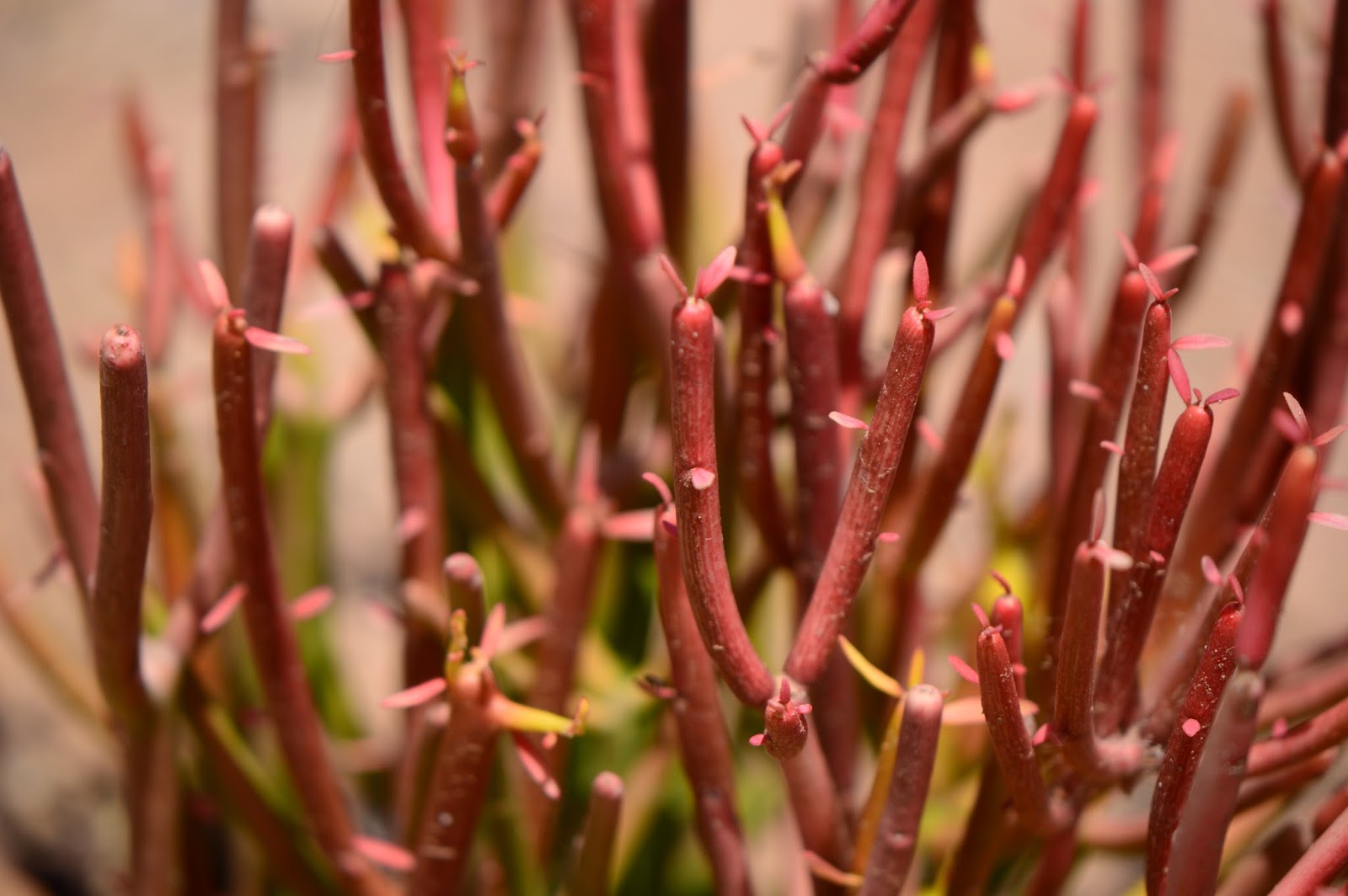
Perhaps the brightest inhabitant of the Corner is a plant with no flowers and little enough in the way of leaves.  Euphorbia tirucalli "Firesticks" is a mass of brilliant, autumn-coloured stems.  According to San Marcos Growers, "Firesticks" is indeed the "Sticks on Fire" of commerce.  Ultimate size is unknown as it is not expected to grow as large as the green-coloured species, which reaches tree size.  I have tried to give it a little room to spread at any rate!
Euphorbia "Firesticks"Euphorbia "Firesticks"
A continual burst of bloom is coming from Tetraneuris acaulis, shown here with a friend.  Unlike the Berlandiera, T. acaulis has put out a fine stand of little yellow daisies while demanding very little water.  This is a wonderful dry-climate plant: vigourous, attractive, bright.  The foliage is very low-growing, but the flowers stand well up on long stems, making the whole effect more visible.
Tetraneuris acaulis, butterfly
Elsewhere in the garden, the transition to summer continues.  Some plants have slowed or ceased blooming, among them the Lavender stoechas varieties, though L. s. "Blueberry Ruffles" seems to be in a state of actual collapse.  L. s. "Madrid", on the other hand, appears to have paused in blooming merely to put on a burst of new foliage.  Rather to my surprise, Eremophila "Outback Sunrise" is still throwing off the occasional bloom.
Eremophila "Outback Sunrise"
Perovskia atriplicifolia has finally begun blooming...
Perovskia atriplicifolia
...and Cistanthe grandiflora continues to send up its exotic flower stalks loaded with buds, flowers, and spent blooms, all like so many baubles dancing in the breeze.
Cistanthe grandiflora
And, no pictures yet, but just today it appears that Salvia elegans will soon be in full bloom.

Well, that is all for this month's update.  As always, I will link with the End of the Month View meme at The Patient Gardener, where many other updates can be followed as well.

One last picture of Anigozanthos "Bush Ranger", the wonderfully deep red flower in the Dry Corner.
Anigozanthos "Bush Ranger"
Weather Diary: Sunny, High: 96 F (35.6 C)/Low: 62 F (16.7 C)

Saturday, February 28, 2015

End of Month View: the Dry Corner in February

Berlandiera lyrata
It's time for the End of Month View, and for the first time I am going to feature one section of the garden.  This is the Dry Corner.  It's not very heavily planted yet, and what is there has yet to fill in.  But it is taking shape a little.  This corner will form the entrance/exit into the rest of the yard.

From the garden side...
End of month view meme
and looking in from the yard...
End of month view meme
It is meant to be home to some of the most adamantly desert natives I am growing - things that should not have much supplemental water at all.  This where the acacia (Acacia salicina) is planted (I do love the colour of the bark)...
Acacia salicina, willow acacia
...and some of the succulents, like Senecio "Blue Fingers"...
Senecio "Blue Fingers"
...and now Euphorbia "Firesticks".  Is this the same as "Sticks on Fire"?  I don't know.  If it is, it can sometimes grow to a considerable height.  At present, it's a little, glowing batch of fingertip branches.
Euphorbia "Firesticks"
There is also a tiny Sedum adolphi, with its plump leaves becoming ever more golden in the sunlight.  It was sold as one of those miniscule succulents-as-houseplants that one finds at garden centres.  It went out into the big world and nearly met with immediate demise.  Betty the dog accidentally ran it down - literally planting her foot in the middle of it - as she greeted me because, of course, I was standing there admiring the new plant.  The main stem was undamaged; and I plopped the other remnants back into the soil.  It worked well with a bit broken off the Senecio.  These look all right so far!
Sedum adolphi, golden sedum
Anigozanthos "Bush Ranger" has been very pleased with this location.  It has just been cut back so is only a tuft of flat, dark green leaves at present.

The Tetraneuris is also in this bed.  For a while it had me worried: the leaves have such a dry, leathery texture that I kept thinking they were dying back.   But no, it is producing a mass of little buds though the leaves still feel dry and crinkly to the touch.  Healthy, I think?
Tetraneuris aucalis
At the moment, some of the strongest bloom is coming from Berlandiera lyrata.  I am happy to report that the chocolate scent is distinctly smellable now.  I can only send the picture...  Here you can see the scalloped leaves that form a rosette at the base of the flower stems.
Berlandiera lyrata, chocolate flower
This bed will need a number of other plants to fill it out, but I thought I would begin focusing on it for the End of the Month View with Helen at the Patient Gardener.

I can't leave today's post, however, without showing the first open bloom of Penstemon parryi.  Just opened this morning!
Penstemon parryi

Monday, February 16, 2015

Monday Vase: Far from the Sea

Today's vase must be considered in the light of an experiment.  The idea was one which I'd had over a month ago: combine succulent foliage - particularly Senecio "Blue Fingers" - with a seashell.  The succulents do sometimes have a curious sea-look to their fleshy leaves, and the seashell will hold water.

All very true, but getting the shell to stay put and not roll over necessitated use of unsightly wads of Sculpey, the polymer clay, all round the base of the shell.  (I tried less at first and spilled water over an envelope all ready to send to the accountant.  I've been that way today - brainless!)  I set everything up on a small mirrored square, and it has stayed successfully in place.

So with that explanation, here is the result.
In addition to the Senecio, I added a sizeable clump of Calandrinia grandiflora foliage.  This plant, which was all but gone last December, has made a heartwarming (frightening?) recovery.  This is the greyer, rounder foliage at the narrow end.  And then four Armeria heads, some nearly spent, some new, were slipped in to complete the effect.
And for those of you who are noticing a totally different look to the blog... well, that may be one reason I've been a little flighty today.  With the template I was using, I had been unable to set up for subscription and the text had somehow become jammed at too small a size.  I've been tinkering off and on for weeks but finally decided that perhaps it wasn't all user error.  It might be my choice of template.  In attempting to change things I went through various adventures, from apparently resetting the template to one I detested, to - much worse - finding that it showed only code... no blog at all...

I think it was worse on this end than anywhere else - some of you may know differently!  At any rate, the blog is reconfigured at last, and it has subscription widgets and 16 pt text.  Maybe the text size is a little too large now?  I'd really appreciate feedback!

Despite it all, I did finally manage to create my experimental seashell project to join with Cathy's Monday Vase meme at Rambling in the Garden.  I'm still intrigued with this idea and hope to play with it again sometime.

Happy Monday!

Thursday, January 22, 2015

Looking at Leaves

Sedeveria "Sorrento"
I got a late start on Garden Bloggers' Foliage Day, but here is the January report.  Mostly pictures...

First the beautiful powder blue and green of  Senecio "Blue Fingers".
Senecio talinoides var. mandraliscae, Senecio "Blue Fingers"
Then the promise of spring flowers from the bulbs.  Dutch Iris "Blue Magic" is up...
Dutch Iris leaves
as is Star of Bethlehem (Ornithogalum arabicum).
Ornithogalum arabicum, Star of Bethlehem
Also there is Dietes irioides, commonly known as Fortnight Lily, whose handsome, deep green fans have just sent out their first bud stalk.  I have been happily impressed with the elegant presence of the Dietes clump and will be even happier as it begins to bloom.  By the way, my aunt recently recommended Dietes (as well as Argyranthemum frutescens, the Marguerite Daisy) for successfully growing under Eucalyptus trees, a notoriously difficult situation for plants.
Dietes irioides, Fortnight lily
All in all, the leafiest plant in the whole garden is probably still the Salvia greggii "Autumn Moon"...
Salvia greggii foliage
but it has some competition for the title from Eremophila "Outback Sunrise", which has yet to flower, but has held its lush green foliage fresh for months.
Eremophila "Outback Sunrise" foliage
Lastly, there are the bronze/purple foliaged plants, which I am learning to appreciate more and more in this garden.  Sedeveria "Sorrento" (see also my post on these earlier this winter) is thriving.
Sedeveria "Sorrento"
I love the purple hues of my newly planted Penstemon parryii.  I suppose the colour will change as the weather warms.
Penstemon parryii foliage
Another recent acquisition is the slightly curly leaves of the little groundcover Tetraneuris aucalis.  The yellow daisies perch on wiry stems some 12 in (30 cm) or more above the mat of leaves.
Tetraneuris aucalis foliage
And finally, once again, there are the smoky leaves of Eremophila "Valentine".  This is proving a superb addition to the garden.
Eremophila "Valentine"
Thanks to Christina for hosting GBFD each month at My Hesperides Garden and for encouraging a good look at the foliage that brings its own grace and beauty to complement the often more ephemeral flowers.

Last of all, a look (almost) upward at the leaves of the little Acacia tree (Acacia salicina, see also here), quietly evergreen... or eversilver...
Acacia salicina

Tuesday, January 13, 2015

Musings on a Microclimate

Bougainvillea, winter damage
The first real cold snap in the little garden is over, and the results are encouraging.  As you can see, temperatures dropped a little below freezing.  They crisped not only the flowers, but also the leaves and branches on the bougainvillea bush that grows against the west side of the house.  (Not to worry, it is fairly sure to come back strongly from the roots.)  Other than the wall, the location offers little protection either in winter or in summer.
bougainvillea, winter damage
The garden itself is on the east side of the patio.  The patio roof shields it from the west, the house wall gives it a little shelter from the north, and a slope allows colder air to drop away more quickly.  That, at least, was the idea when I chose the location.  My experiment with microclimate seems to be working thus far, with tender plants sustaining little or no damage from the frost.

I was rather concerned about the succulents, in particular Senecio "Blue Fingers" in the newly planted corner at the bottom of the garden.  Perhaps a few marks from the cold, but nothing to cry about.  It is looking very vigourous, and the broken-off section that I poked in next to the main plant is settling in well.  I covered both with a bit of hay - the only thing I could get hold of in a hurry - when temperatures dropped low, but no other protection was needed.  I'm not even sure it needed the hay.  Perfectly pleased with itself!
Senecio "Blue Fingers", Garden succulent
A plant that I had questions about trying at all is the Russelia.  Native to Guatemala and Mexico, it is definitely frost-tender though it is said to come back well from the roots if cut down by a little too much cold.  I positioned it right up next to the patio as I thought the concrete would hold some warmth for it.  I did not so much as cover it with hay, but it has breezed through the cold snap lush and green, as if unaware of anything unusual.  It has, however, held its many buds closed for weeks longer than I expected.  That may have been due to the cold.  Just a few are open.
Russelia equisetiformis, Coral Fountain, Firecracker Plant
The newly-planted Penstemon parryi received a little protection.  It is an Arizona native and fully hardy, but I thought it might be damaged simply because it was so freshly planted.  It seemed to feel a bit suffocated under the hay and is much happier now that its stalk is out in the open.
Penstemon parryi
And throughout the garden the flower buds are unscathed.  The rosebuds, predictably, had no objections to a mild freeze.
"Sterling Silver" rose, rosebud, winter-blooming, hybrid tea rose
Rose "Sterling Silver", hybrid tea rose, winter-blooming
The Tetraneuris, in the new corner with the Senecio, is smiling.
Tetraneuris, winter-blooming
And the buds on the young Eremophila "Valentine" are still plentiful.
Eremophila "Valentine", winter-blooming

Pardon me for gloating a little.  The results from the first microclimate test are very satisfactory!
Eremophila "Valentine"