Showing posts with label cactus. Show all posts

Saturday, July 24, 2021

Six on Saturday: from the Monsoon Rains


 It's all about the rain right now.  Here at our new home, this month's monsoon rains have been torrential but much-appreciated by the growing things.

When we arrived, most of these plants were leafless or looked to be dead or dying.  But the rains have been falling for several weeks now, and the results are delightful.

At the top of the page is sweet acacia (Vachellia farnesiana) in full bloom.  The lot is full of these, ranging from small trees down to shrubs on down to sprouts and seedlings at ground level.  I shall have to begin weeding them out, there are so many!  The scent is wonderful.

The palo verdes are leafing out as well.  Their bloom time is mid-spring, but they are breaking their summer-deciduous dormancy in response to the rain.

I realize as I write this that I've assumed this is Parkinsonia florida, the blue Palo Verde, but I haven't checked it out.  There are some other wild varieties in southern Arizona, and I need to confirm just which one this is.  Lovely, in any case.


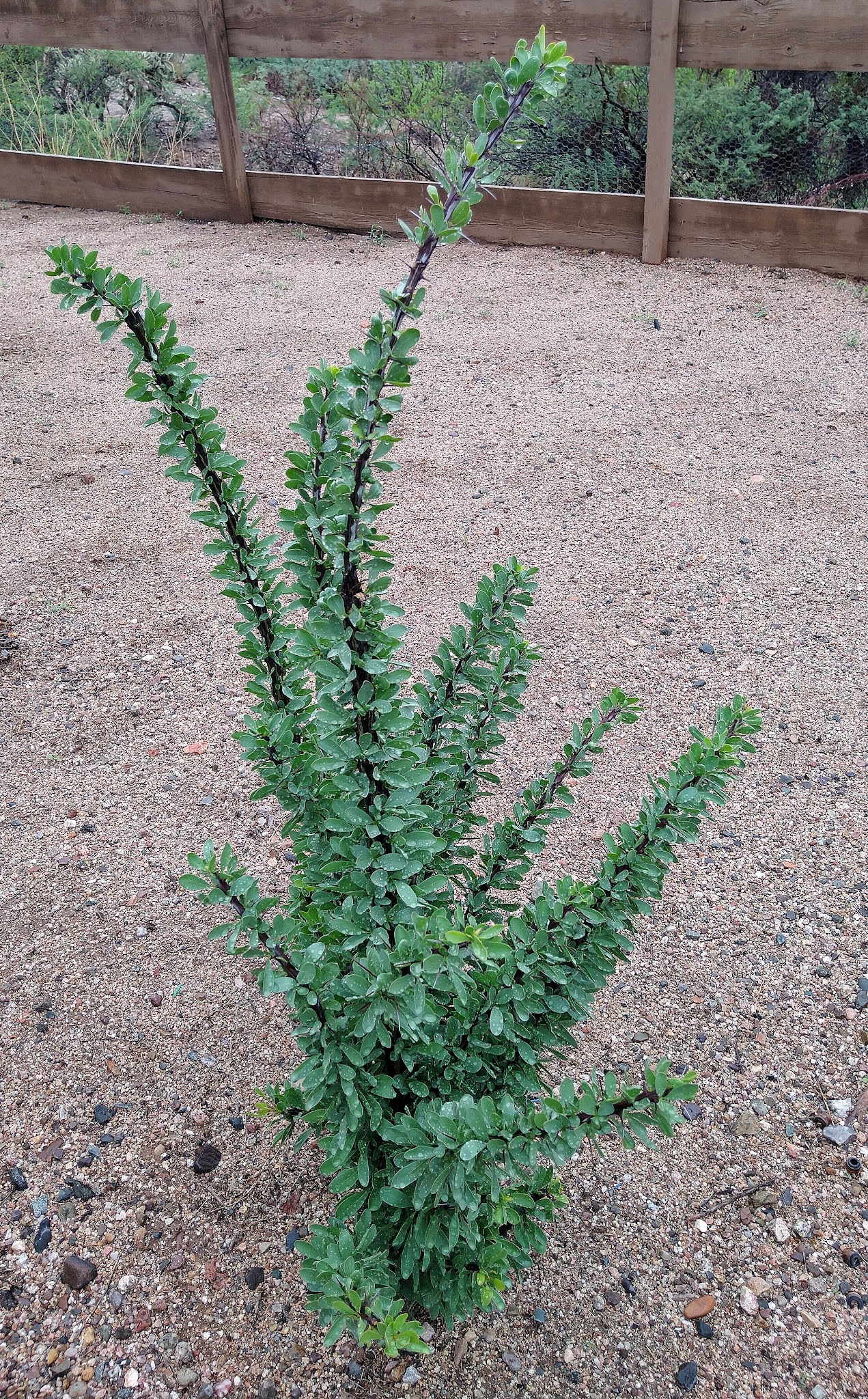
Another plant that was leafless when we arrived is this smallish ocotillo (Fouquieria splendens), which is now such a mass of leaves that those long thorns are nearly invisible.  I've wanted an ocotillo of my own for years, and here is one already in the ground and, apparently, thriving.  

It did look like a cluster of dead sticks when we arrived, but that is to be expected of an ocotillo in June.  It responded with leaves within two or three days of my giving it a quick spray of water.  (Temperatures were at record highs when we arrived.)  Since then the monsoon rain has kept it quite happy.


No leaves sprout on cacti, of course, but the young saguaro has clearly been drinking heartily.  Its ribs feel taut to the touch right now!

I consider it an honor, more than anything else, to have a saguaro in my garden.  I've taken the liberty of christening this one Bungo.


Lastly come the flowers.

The two half-price Salvia farinacea that I rescued are settling in nicely beneath the small kumquat...


...while the kumquat itself is recovering well.  Its leaves were withering and ready to drop when we came.  Now it not only has new growth but has begun to flower as well.  Yes, the scent is delicious.


Not a bad six for a start, I think!  After a difficult time leaving Missouri, followed by a rough first month here, (we were frankly sick with the stress and fatigue of it all) it looks like we are settling in.  I'll be posting more soon, if all goes well.  There is so much to discover here, and it is certainly a different part of the desert than my previous garden.  Still the Sonora, but at about 4000 feet elevation as well as further south.  There will be much to learn.

Meantime, this is my first Six on Saturday post, linking with the Propagator's weekly theme.  I've looked forward to participating but decided to wait until I could start blogging and gardening anew here.

Friday, September 23, 2016

Garden Foliage in September

garden bloggers foliage day, gbfd, raindrops, photography, amy myers, desert garden, small sunny garden, muhlenbergia, regal mist
Perhaps because we receive so little rain here (averaging about 8 in/20 cm per year), it is magical when it does come, inducing the gardener to go out and stand in it, watching the plants as they drink it in.  Also fascinating is to watch how the foliage holds raindrops, creating transient patterns of light and reflection otherwise absent in the garden.

Each plant is different.

Layers of drops rest in among the layers of close-set leaves on Callistemon viminalis "Little John"...
garden bloggers foliage day, gbfd, raindrops, photography, amy myers, desert garden, small sunny garden, callistemon, little john
...while the agaves hold theirs as if on a wide platter...
garden bloggers foliage day, gbfd, raindrops, photography, amy myers, desert garden, small sunny garden, agave
Agave parryi (I think!)
garden bloggers foliage day, gbfd, raindrops, photography, amy myers, desert garden, small sunny garden, agave, marmorata
Agave marmorata
...or caught along the edge.
garden bloggers foliage day, gbfd, raindrops, photography, amy myers, desert garden, small sunny garden, agave, angustifolia, marginata
Agave angustifolia marginata
On cacti the drops may be beaded among the spines.
garden bloggers foliage day, gbfd, raindrops, photography, amy myers, desert garden, small sunny garden, cactus, trichocereus, spachinanus
Trichocereus spachianus
The fern-like foliage of Caesalpinia pulcherrima carries raindrops in glittering sprays.
garden bloggers foliage day, gbfd, raindrops, photography, amy myers, desert garden, small sunny garden, caesalpinia pulcherrima, red bird of paradisegarden bloggers foliage day, gbfd, raindrops, photography, amy myers, desert garden, small sunny garden, caesalpinia, pulcherrima, red bird of paradise, pride of barbados
garden bloggers foliage day, gbfd, raindrops, photography, amy myers, desert garden, small sunny garden, caesalpinia, pulcherrima, red bird of paradise, pride of barbados
And the grass Muhlenbergia capillaris "Regal Mist" carries perfect rows along its round blades.
garden bloggers foliage day, gbfd, raindrops, photography, amy myers, desert garden, small sunny garden, muhlenbergia, capillaris, regal mist, muhly grass
Each rainfall is different as well; this was a very gentle, light rain that left plenty of large drops hovering around the garden.  But it is fascinating to consider the patterns formed between the plants and the rain.

Thanks to Christina at My Hesperides Garden for hosting the Garden Bloggers' Foliage Day, which inspired this post.
garden bloggers foliage day, gbfd, raindrops, photography, amy myers, desert garden, small sunny garden, agave, artemisia, powis castle
Agave angustifolia marginata with Artemisia "Powis Castle"
If you have time, please check my last post as well, in which I look at some new plans for the blog and ask about what would be most at issue for my readers as I change over.
garden bloggers foliage day, gbfd, raindrops, photography, amy myers, desert garden, small sunny garden, ruellia brittoniana
Ruellia brittoniana
Weather Diary: Partly cloudy; High: 83 F (28 C)/Low: 64 F (18 C); Humidity: 14%-89%

Wednesday, August 10, 2016

Tuesday View

Once again it's time for the Tuesday View with Cathy at Words and Herbs.  Here is the South Border, early August.

The weather has been tough on the garden this past week.  After a heavy dust storm, followed by a light rainfall, temperatures soared and everything dried out rather quickly.  In fact, I think I depended too much on that rainfall and failed to get water to some plants when they needed it.  The result of it all has been another round of plant losses, most importantly including Alyogyne huegelii, a structural plant in the South Border.

I'm a bit surprised at this one since the Alyogyne seems a sufficiently sturdy plant.  But it was planted last winter; and although it has looked fairly good overall, I don't think it had fully settled in, and this summer has been particularly difficult for new plants.  I do intend to replace it with another as I think it should be a good choice here in the long run.

Nearby, Perovskia atriplicifolia is holding its own, though not able to bloom much.
Sparsely flowered Perovskia with browned leaves of Alyogyne huegelii in front
On the other hand, Iris "Clarence" is set to try blooming again.
Notice the buds on Leucophyllum frutescens also; hopefully it will soon be in bloom as well!

The rest of the border looks fairly good.  The rosemary hedge has perked back up.  And Lagerstroemia indica "Rhapsody in Pink" is in its summer glory, despite its small size.
One of the most noticeable changes as the year wears on is the lengthening stems on both the grasses.  Pennisetum setaceum rubrum is now tumbling over the Catharanthus in front of it.
And finally, despite the weather, I decided to go ahead and plant one new addition: a very small one.
 Melocactus azureus will be protected by the nearby miniature rose so I thought I could afford to slip it into the ground.  As it had been blown clean out of its pot by last week's dust storm, I thought it was just as well to protect it from further indignities of that sort.  I gave it a week without water according to the advice of desert gardening author Mary Irish (though I believe her recommendation applied chiefly to bare root cacti), and then gave it a little nook at the front of the border.  It can just be seen under the rose bush.
It may not last very long here; apparently it is fairly cold-sensitive, which I didn't realize when I bought it.  But I wanted to give it a try in the border as that was why I purchased it to begin with.  I think it is pleased to be there for now after its adventures rolling around in the storm!

There is another chance for rain tonight...!
Weather Diary: Partly cloudy; High: 100 F (38 C)/Low: 84 F (29 C); Humidity: 29%-52%


Sunday, August 7, 2016

A Walk in the Desert

ferocactus, cactus, sonoran, desert, small sunny garden, amy myers, photography
On Friday morning I took a small hike in the empty desert around our home.  It began as part of my annual quest to view wild cactus in bloom.  We've had a few rainy days and the wild fishhook cacti (Ferocactus sp.; I'm not very confident about identifying wild species and have given this one various names even here on the blog) usually begin to bloom as the monsoon rains provide a bit of moisture.  So I headed out, equipped with boots and camera, to check our nearest wild cactus.

So far, one bud has colored up but not opened.
ferocactus, fishhook cactus, sonoran, desert, small sunny garden, amy myers, photography
Perhaps I have missed some earlier blooms?  This is quite a bit later than they have bloomed the last couple of summers.  This year has been very dry with little intermission from high heat, and even our recent rains have been scant.  Humidity has risen, but the soil is still quite dry.  The cactus is biding its time.
ferocactus, fishhook cactus, flower, sonoran, desert, small sunny garden, amy myers, photography
After seeing the cactus, I began paying more attention to what the other wild plants were doing in response to the weather.  Here is a look around.

When one thinks of desert plants, the succulents usually come to mind.  Cactus and agave plants store water in modified stems and leaves, respectively.  But our area is a lowland populated largely by small trees and shrubs (there is not much to distinguish the two as all are bushy and size is mostly a question of available water).   With these plants one of the most dramatic ways of coping with intense drought is leaf drop, which reduces moisture loss from leaf surfaces.  This year many of the drought-deciduous species are nearly or entirely without leaves.
sonoran, desert, small sunny garden, amy myers, photography
Wild Palo Verde growing alongside our street
 This mechanism is sometimes offset by an ability to conduct photosynthesis through something other than leaves.  Here is a branch of Blue Palo Verde (Parkinsonia floridum), whose soft green bark carries on the task through the dry summer months.
parkinsonia, sonoran, desert, small sunny garden, amy myers, photography
Not so with the wolfberry below.   Yes, trust me, this plant is alive.  It looked like this last summer too!  Eventually it will leaf out again and bear its scruffy white flowers and red berries.  Again, I don't know what species of Lycium this is; there are at least three or four common in the Sonoran Desert, and I certainly don't know enough to ID it in this condition!
wolfberry, lycium, sonoran, desert, small sunny garden, amy myers, photography
The very image of "drought-deciduous": Lycium and wild grasses...
With so few leaves around, the very thorny nature of the desert becomes more evident.
sonoran, desert, small sunny garden, amy myers, photography
I have no idea what this shrub is, but here one can again see the pale green of the younger branches - and the nasty thorns, protecting a few miniscule leaves.
sonoran, desert, small sunny garden, amy myers, photography
Other desert plants are much gentler.  This is Larrea tridentata (Creosote bush) in its spare, striped, summer elegance.
larrea tridentata, creosote, bush, sonoran, desert, small sunny garden, amy myers, photography
A few seedpods can be seen dangling from its branches.  The rain may yet bring out a light flush of yellow flowers, but I don't see any so far.
larrea tridentata, creosote bush, seeds, sonoran, desert, small sunny garden, amy myers, photography
The leafiest plants are probably the mesquites (Prosopis velutina).  Though they can make sizeable trees, this one grows low and spreading.
sonoran, desert, small sunny garden, amy myers, photography, mesquite
It too, has dropped most of its canopy.
mesquite, prosopis, velutina, sonoran, desert, small sunny garden, amy myers, photography
Two years ago, in response to record rainfall, the arroyo just beyond was lush, full of grasses and wildflowers.  This year the ground is bare, much like the higher ground all around.    Here is the view looking back toward our lot.
sonoran, desert, small sunny garden, amy myers, photography
Most of our rainfall is expected during the winter months.  Native plants are well-adapted to dry summers.  But monsoon rains are normal, as I keep mentioning to the clouds as they sail over, leaving their precious moisture elsewhere.

Meantime, life in the dry lands goes on.
cholla, opuntia, journal of a thousand things, sonoran, desert, small sunny garden, amy myers, photography
Bird's nest in cholla cactus
For more shots of the very well-protected bird's nest we found down in the arroyo, see my other blog at Journal of a Thousand Things.
larrea tridentata, creosote bush, sonoran, desert, small sunny garden, amy myers, photography, seeds
Larrea tridentata (Creosote bush)
Weather Diary: Fair; High: 106 F (41 C); Low: 83 F (28 C); Humidity: 20%-56%


Saturday, March 19, 2016

Another Plant in Flower...

mammillaria elegans, cactus, desert garden, cactus flower, small sunny garden, amy myers, photography
I missed posting pictures of cactus flowers in my Bloom Day post.  Here is my recently planted Mammillaria elegans, just a very small mound of white and pink starbursts right now.  And yes, quite elegant, I think!
mammillaria elegans, cactus, desert garden, cactus flower, small sunny garden, amy myers, photography
Apparently I was not supposed to plant it out until the weather warmed up.  However, it didn't seem to mind and has settled in.  And as the weather is heating up nicely this week, I expect it to do well!

The spines seem to be more or less harmless, and the whole effect of the little plant is charming.
mammillaria elegans, cactus, desert garden, cactus flower, small sunny garden, amy myers, photography
Weather Diary: Fair; High: 89 F (32 C)/Low: 55 F (13 C)

Sunday, February 14, 2016

About the Desert Garden, Part 2

small sunny garden, amy myers, sonoran desert
A shady spot just after winter rain
Well, it has taken me a good deal longer than expected to write this post!  In this one I am looking at the immediate environs of the small sunny garden.

There are, of course, many different regions within the Sonoran Desert.  There is considerable variation even across the city of Phoenix.  Our patch (and not a small one!) is influenced by the proximity of the Hassayampa River.

Rivers and aqueducts in the desert are fascinating things with their bright waters flowing through barren plains while herons and other water birds trace their courses overhead.  But the Hassayampa River is not like these, being mostly underground with only short sections of flow perennially on the surface.  Its name, in fact, is said to mean the "Upside-Down River" -- a very apt description!

But for all that, the land here does have the feeling of a river valley, a lowland; and when it rains we don't argue with it, having been stranded in our vehicle overnight during one of the deluges of 2014... about a mile from home, with rushing water blocking the road both behind and in front of us.  It was not a dangerous situation so long as one stayed put, but I must admit it required a good deal of patience!  The waters subside about as quickly as they come, but in rainy seasons there is often significant flooding as the excess waters pass through the many washes that stripe and gully the area.  Rainwater seems to move across the soil much further than it penetrates into it.

A second factor, also important to the garden, is proximity to more mountainous terrain.  This allows our temperatures to be a little lower -- both summer and winter -- than areas closer to the city.  Some freezing nights are to be expected; summertime highs are supposedly not as extreme though still hot enough!  The highest temperature I noticed last summer was 114 F/46 C, and we had two stretches of freezing nights during this last winter.
hassayampa drainage, small sunny garden, sonoran desert
Looking across the nearby ranch at the Vulture Mountains in winter
Quick mountain upthrusts are divided by the flattest of plains.  With this "riverbottom" topography, it is no surprise that much of the soil in these flat lands is fine-grained clay, topped with a rough detritus of gravel and small rock.
soil surface, desert, sonoran desert
 In our nearby washes, this changes to a softer topping of sand or else much heavier rock.

These washes are in turn home to their own tiny ecosystems: little thickets of desert trees and seasonal grasses and wildflowers.  These shift gradually to the creosote and saguaros of the plains, making a varied tapestry across the whole area.

The most common trees in our neighborhood are the mesquite (Prosopis velutina) with its delicate leaves...
prosopis velutina, foliage, mesquite, small sunny garden, amy myers, sonoran desert
...and muted yellow chenille catkins...
small sunny garden, amy myers, sonoran desert, prosopis velutina, bloom
...and the Blue Palo Verde (Parkinsonia floridum), which in spring can be a glory of yellow flowers.  (For more on the nearby Palo Verde, which I have written about through most of 2015 with the Tree Following meme, see here.)
parkinsonia floridum, blue palo verde, bloom, spring, small sunny garden, amy myers, sonoran desert
Both these trees are legumes and provide important food for wildlife from their pods.
parkinsonia floridum, blue palo verde, small sunny garden, amy myers, sonoran desert, seedpods
The low-lying areas tend to host ephemeral flowers and grasses.  There are many different grasses, but they are perhaps best looked at as a specimen plant here, growing in tufts and swathes rather than a solid cover.
small sunny garden, amy myers, sonoran desert, wild grasses
In moist years there is, of course, the marvelous glow of Kallstroemia grandiflora, known as Calltrop or Desert Poppy, but in fact a relative of the Creosote Bush!
kallstroemis grandiflora, calltrop, desert poppy, arizona poppy, desert wildflower, small sunny garden, amy myers, sonoran desert
Probably the most common wildflower in our neighborhood is Globemallow (Sphaeralcea ambigua), which seems to thrive even in drier conditions so long as there is some shade.  Brilliant coral orange (there is some variation) flowers bloom on large, gawky plants with soft, silvery, lobed foliage.  Bloom time follows rain, but these seem to be fairly reliable plants even during drier years.  They are offered as garden perennials, though their size limits placement as they can have a tremendous sprawl!
sphaeralcea ambigua, globemallow, small sunny garden, amy myers, sonoran desert, desert wildflower
And if you watch carefully, there are the tiny bells of Dichelostemma capitatum, a cormous species which sprouts in the most inhospitable places.
small sunny garden, amy myers, sonoran desert, dichelostemma capitatum, blue dicks, desert wildflower
Moving onto even higher ground one finds the iconic saguaro cactus (Carnegiea gigantea), but they are not so frequent here as they are on the rocky hillsides in other parts of the region.  
small sunny garden, amy myers, sonoran desert, carnegiea gigantea, saguaro, cactus, hassayampa drainage
Carnegiea gigantea, with small scattered shrubs of Larrea tridenta (see below) at their feet
Two other cactus species are common locally: the showiest is the Barrel or Fishhook Cactus (Ferrocactus emoryii), with its brilliant red blooms which open just as summer rains begin.
ferrocactus emoryii, barrel, fishhook, small sunny garden, amy myers, sonoran desert
It is not so spectacular the rest of the year, but still worth looking at and walking carefully around!
ferrocactus emoryii, barrel, fishhook, cactus, hassayampa drainage, small sunny garden, amy myers, sonoran desert
At rough estimate, this one is about 3.5 ft (1 m) tall
There are also the Chollas (Opuntia spp.), some of the prickliest of them all.  Unlike the Ferrocactus, these grow happily in the wash in our neighborhood and their pale green blends in with the grasses of the monsoon season.
opuntia, cholla, cactus, hassayampa drainage, small sunny garden, amy myers, sonoran desert
But in this area the most definitive plant is probably the so-called Creosote Bush (Larrea tridentata).  It spreads (in sparse desert fashion) across the empty areas, forming a shrubby green haze that gives an illusion of verdure.  It tends to be spaced widely, and I have read that it exudes a chemical that inhibits growth of nearby plants, though other sources say nothing about this and it seems to be acceptable for garden use.  
creosote, larrea tridentata, small sunny garden, amy myers, sonoran desert
Its fresh, sharp scent fills the air when the weather turns moist.  It grows either low or high, depending on the availability of moisture.  Never (so far as I know) entirely leafless, it puts on a new flush of glossy foliage during wet seasons, then adds some admittedly non-descript yellow blooms...
larrea tridentata, flower, bloom, creosote, small sunny garden, amy myers, sonoran desert
...later accompanied by silver puffballs of seed.
larrea tridentata, creosote, seeds, small sunny garden, amy myers, sonoran desert
  And when nearly bare, its striped branches are fascinating in themselves.
larrea tridentata, creosote, small sunny garden, amy myers, sonoran desert
As can be imagined, where there is a little more water, there will also be animals.  Lizards are plentiful...
small sunny garden, amy myers, sonoran desert, lizard,
...but we also have a plethora of toad species, from various spadefoots (which I think is the type below) to the Colorado River toad, whose poison glands present a serious danger to dogs unwary enough to pester them.  In moist weather in summer, the air is full of the sound of singing toads!  They do a noticably good job of bug control.  (They may also attract rattlesnakes, which I am not looking at in this post, though they are plentiful...)
small sunny garden, amy myers, sonoran desert, toad
Also associated with the presence of water are the dragonflies which occasionally appear.
small sunny garden, amy myers, sonoran desert, dragonfly
Happily, there are also plenty of bees!
bee, ferrocactus, barrel, cactus, flower, small sunny garden, amy myers, sonoran desert
Bee in Ferrocactus flower

 And I had better not start on birds (particularly since there are many common ones for which I have no photos!)  Just a few...
Haemorhous mexicanus, house finch, amy myers, sonoran desert, small sunny garden
House Finch, originally native here though it spread across much of the rest of the country during the last century
Toxostoma curvirostre, curve-billed thrasher, sonoran desert, small sunny garden, amy myers
Curve-billed Thrasher
Calypte anna, annas hummingbird, small sunny garden, sonoran desert, amy myers
Female Anna's Hummingbird in the garden
So that is the lie of the land: a dry lowland across which the rain waters have carved themselves innumerable -- and inalienable -- rights of way.    But those same waters make for a fascinating wealth of plant and animal life.  And as the plants think it is a more hospitable area to grow and bloom, it must be a good choice for a garden!
larrea tridentata, creosote, desert, sonoran, small sunny garden, amy myers