It's roughly time for the monthly look at foliage in the garden; and despite being in the midst of final preparations for Christmas, I wanted to share some leaves today. I have been admiring the assortment of purple-foliaged plants that increase the colour range even when out of bloom.
With some, this seems to be a response to cooler weather. Penstemon parryi has turned a luscious metallic purple.
Some leaves are greener than others, but the whole effect is striking and makes this single plant fairly spectacular during the cooler months.
The nearby Eremophila maculata "Valentine" is more purple than it was, though the myriad of tiny red flowerbuds may be creating much of the colour change. Still, its leaves run to smoky purple during winter and make an excellent foil to those little buds, which grow much larger before they burst into brilliant bloom. This is one of the Australian shrubs which has proven its value here in the Sonoran desert, taking well to the soil and minimal water, and not flinching in the overpowering sun and heat of summer.
Mine has grown a good deal since it was planted late last year, and it now forms a respectable shrub, seen here with Penstemon parryi in the background.
Pennisetum rubrum is named for its maroon-purple leaves, now very strongly coloured.
On other plants, the purple and red leaves are new growth, the brightly coloured bursts of young foliage.
On Caesalpinia pulcherrima (Pride of Barbados, among many other names), the hue is blended with copper tones.
On the just-planted Calliandra californica "Baja Red", a young Baja Fairy Duster bush, the colour is quite strong (see also the picture at top of post)...
...but still not so bright as the one flower this young plant is sporting!
And of course, there is the classic red new growth of roses, best supplied at the moment by miniature rose "Daniela".
Aside from the question of whether the plant still qualifies as miniature (it has grown robustly over the last few months), this is a highly successful bush. Red new growth and bright red blooms...
...and the foliage colours form a quiet blending with the bracts on nearby Salvia greggii "Autumn Moon"...
...with its delicate twin flowers.
Purple, reddish, smoky hues help create a softer mood in this climate where high contrast is produced automatically by the strong sunlight (not quite so strong over the last few days, but that is a different matter!)
Weather Diary: Partly cloudy; High: 64 F (18 C)/Low: 52 F (11 C)
A small garden in the English style, set in the wilds of the northern Sonora Desert...
Showing posts with label Australian plants. Show all posts
Wednesday, December 23, 2015
Saturday, August 22, 2015
Waiting in the Wings
The collection of plants waiting in pots is growing. Growing in more ways than one. Some will need a trim when they are planted!
I have finally collected all of them in one spot.
I had worried several times that I would be forced to plant the Convolvulus no matter what the weather. But it has very obviously taken its life on the patio quite well even without repotting! I love this foliage.
A couple of selections were already planted on into the garden despite full summer temperatures. Caesalpinia pulcherrima went in because it was growing so well in high heat that I thought it might just as soon put that energy into garden growth. So far my decision is borne out by its robust appearance.
Lagerstroemia indica "Dynamite" was more of a rescue case. It was already reaching the dangerous stage when I bought it - hence its bargain status - and it continued a cycle of frequent wilting when I brought it home. Despite this the plant looked good overall. I assumed it was rootbound until I checked more closely. The problem was simply that the soil in the container was so open that the pot could not retain enough water for the roots. Rather than repot, I plonked it into its permanent spot in the garden and have been thrilled with the results.
The rest of my summer-purchased plants, however, are simply waiting for cooler weather. I would like a bit more rain, too, to soften up the ground and make digging easier!
It's not a bad little collection, consisting entirely of blooming shrubs with attractive foliage. It's an unusual posting for Garden Bloggers' Foliage Day, hosted by Christina at My Hesperides Garden; but I think these shrubs represent a good start for the next planting season.
The most recent addition to the group was Ozothamnus diosmifolius, which I bought just three days ago after standing at the GC doing an emergency search as to what in the world... Turns out it's another Australian native. The flowers are said to be small and remain budlike, and are useful for flower arranging. The height ranges from about 5 ft - 6.5 ft (1.5 m - 2 m), but growth habit seems to be upright and narrow. We shall see... This variety is simply labelled Dark Pink... or was that Deep Pink...? I don't think it's a varietal name, just a description! Anyhow, I like the feathery green foliage which, like some of the other Australian plants, is brighter in hue than many of the drought tolerant American species.
An exception to that statement is the silver-leaved plant next to it, another Aussie, Eremophila hygrophana, which blooms with soft lilac-blue bell flowers.
Convolvulus cneorum and Leucophyllum frutescens "Compacta" (this is the sister plant to one already in the garden) have received their due in other posts. And there is a nicely rooted cutting of Rosemary "Tuscan Blue". After clipping my baby hedge last spring, I tried starting some cuttings; but since I had no way to keep them humid without intolerable heat, most of them failed. Of course! But two did pull through. This one looks particularly good, and I am inordinately proud of this little plant. I'm hoping to start a good many more come autumn.
Just waiting! It won't be too long now...
Weather Diary: Sunny; High: 104 F (40 C)/Low: 84 F (29 C)
| Leucophyllum frutescens "Compacta" (which is NOT a vine) and Convolvulus cneorum |
| From left to right: Eremophila hygrophana, Ozothamnus diosmifolius, Rosmarinus "Tuscan Blue", Leucophyllum frutescens "Compacta", and Convolvulus cneorum) |
A couple of selections were already planted on into the garden despite full summer temperatures. Caesalpinia pulcherrima went in because it was growing so well in high heat that I thought it might just as soon put that energy into garden growth. So far my decision is borne out by its robust appearance.
Lagerstroemia indica "Dynamite" was more of a rescue case. It was already reaching the dangerous stage when I bought it - hence its bargain status - and it continued a cycle of frequent wilting when I brought it home. Despite this the plant looked good overall. I assumed it was rootbound until I checked more closely. The problem was simply that the soil in the container was so open that the pot could not retain enough water for the roots. Rather than repot, I plonked it into its permanent spot in the garden and have been thrilled with the results.
The rest of my summer-purchased plants, however, are simply waiting for cooler weather. I would like a bit more rain, too, to soften up the ground and make digging easier!
It's not a bad little collection, consisting entirely of blooming shrubs with attractive foliage. It's an unusual posting for Garden Bloggers' Foliage Day, hosted by Christina at My Hesperides Garden; but I think these shrubs represent a good start for the next planting season.
The most recent addition to the group was Ozothamnus diosmifolius, which I bought just three days ago after standing at the GC doing an emergency search as to what in the world... Turns out it's another Australian native. The flowers are said to be small and remain budlike, and are useful for flower arranging. The height ranges from about 5 ft - 6.5 ft (1.5 m - 2 m), but growth habit seems to be upright and narrow. We shall see... This variety is simply labelled Dark Pink... or was that Deep Pink...? I don't think it's a varietal name, just a description! Anyhow, I like the feathery green foliage which, like some of the other Australian plants, is brighter in hue than many of the drought tolerant American species.
An exception to that statement is the silver-leaved plant next to it, another Aussie, Eremophila hygrophana, which blooms with soft lilac-blue bell flowers.
Convolvulus cneorum and Leucophyllum frutescens "Compacta" (this is the sister plant to one already in the garden) have received their due in other posts. And there is a nicely rooted cutting of Rosemary "Tuscan Blue". After clipping my baby hedge last spring, I tried starting some cuttings; but since I had no way to keep them humid without intolerable heat, most of them failed. Of course! But two did pull through. This one looks particularly good, and I am inordinately proud of this little plant. I'm hoping to start a good many more come autumn.
Just waiting! It won't be too long now...
Weather Diary: Sunny; High: 104 F (40 C)/Low: 84 F (29 C)
Thursday, April 30, 2015
The Dry Corner in April
A small burst of bloom from the Kangaroo Paws - Anigozanthos "Bush Ranger" - is a wonderful touch for this month's End of Month View from the garden. I missed last month, but in February I began focusing this theme on the Dry Corner.
The Dry Corner is a patch at the entrance/exit to the garden, the point at which one walks out into the big world (generally headed straight to the horse corrals). As it is furthest from the shade of the patio, I decided to make it the area where I used the most obviously xeric plants. This gives it a little different character than the rest of the garden, but also allows me to trial some wonderful species in an area reserved for their preferences.
I have developed the garden more or less from the edge of the patio downward (the west edge of the garden), though gaps exist throughout. So the east border, with the Dry Corner at one end, is one of the least fully planted areas. Featuring it for the end of the month view has changed that a little. I have gone ahead and added a few plants over the last couple of months. Here we are now...
It all looks very sparse still! But additions include Crassula "Campfire" in the foreground (foliage is colouring up nicely now it is in full sun)...
and a second Anigozanthos behind it - just a clump of rather dubious foliage at present; this was one of my recent purchases from the discount shelf so no picture available yet! To the far left is Senna nemophila. This young Australian shrub gave a few of its yellow blooms in early spring. The showing was rather brief, followed by one lone seedpod, since removed. It has not settled in as easily as I hoped. It is always a rather scantily clad bush, with its lovely narrow leaves forming a haze of pale green. However, there is quite a bit of yellowing of leaves, and some leaf drop. I don't know why at this point since this is said to be a well-adapted plant for the region. The second picture is from early March, when the few blooms appeared.
It grows just below the anchor of the Corner, which is the more or less weeping Acacia salicina. It has put out quite a bit of new growth this spring and is now officially taller than I am though its head droops such that the increase in height is not terribly obvious. But it is looking healthy and happy. It is hard to photograph as the stake bracing it is so much heftier than the tree itself. Here is a close-up of the leaves, at any rate!
Another new plant is Lampranthus vygie "Lilac Mist" (I think that is the name - it's too late at night to go check!) just on the edge of the panorama view above. It had plenty of flowers - hot pink rays and yellow centres - when I bought it, but they collapsed upon planting. Foliage is blue-green and rather attractive. I say this despite the fact that somehow I developed a rather negative attitude towards ice plant varieties generally - a silly attitude given their usefulness in extremely difficult garden situations! Perhaps growing this one will encourage a more positive view of them.
So much for the newbies! There are also the plants that have been in place for some months. The most noticeable are still the Berlandiera lyrata with its bright yellow daisies and Senecio "Blue Fingers", a handsome clump of the bluest foliage in the garden. Berlandiera has been blooming for months. I have found that it does need a fair amount of water to support this habit! For that reason I am debating relocating it, but perhaps not since it seems so well pleased with its current position. Besides, it's pleasant to be greeted by that chocolate scent on my way in and out of the garden.
Senecio keeps promising to bloom. It is biding its time. Although I am not growing it for the flowers, still the suspense does build up with a plant that sets buds and then holds them unopened for weeks.
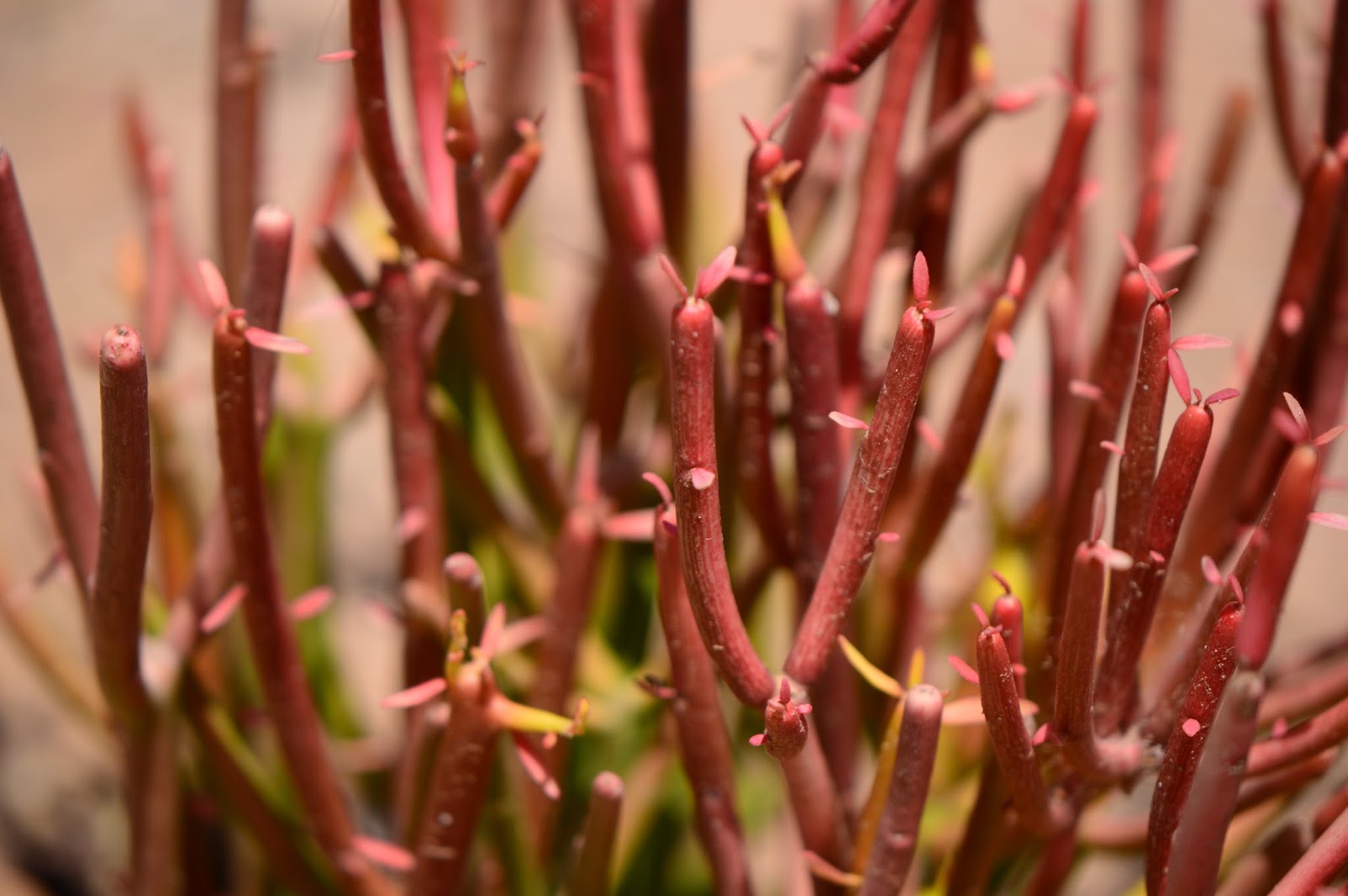
Perhaps the brightest inhabitant of the Corner is a plant with no flowers and little enough in the way of leaves. Euphorbia tirucalli "Firesticks" is a mass of brilliant, autumn-coloured stems. According to San Marcos Growers, "Firesticks" is indeed the "Sticks on Fire" of commerce. Ultimate size is unknown as it is not expected to grow as large as the green-coloured species, which reaches tree size. I have tried to give it a little room to spread at any rate!
A continual burst of bloom is coming from Tetraneuris acaulis, shown here with a friend. Unlike the Berlandiera, T. acaulis has put out a fine stand of little yellow daisies while demanding very little water. This is a wonderful dry-climate plant: vigourous, attractive, bright. The foliage is very low-growing, but the flowers stand well up on long stems, making the whole effect more visible.
Elsewhere in the garden, the transition to summer continues. Some plants have slowed or ceased blooming, among them the Lavender stoechas varieties, though L. s. "Blueberry Ruffles" seems to be in a state of actual collapse. L. s. "Madrid", on the other hand, appears to have paused in blooming merely to put on a burst of new foliage. Rather to my surprise, Eremophila "Outback Sunrise" is still throwing off the occasional bloom.
Perovskia atriplicifolia has finally begun blooming...
...and Cistanthe grandiflora continues to send up its exotic flower stalks loaded with buds, flowers, and spent blooms, all like so many baubles dancing in the breeze.
And, no pictures yet, but just today it appears that Salvia elegans will soon be in full bloom.
Well, that is all for this month's update. As always, I will link with the End of the Month View meme at The Patient Gardener, where many other updates can be followed as well.
One last picture of Anigozanthos "Bush Ranger", the wonderfully deep red flower in the Dry Corner.
Weather Diary: Sunny, High: 96 F (35.6 C)/Low: 62 F (16.7 C)
The Dry Corner is a patch at the entrance/exit to the garden, the point at which one walks out into the big world (generally headed straight to the horse corrals). As it is furthest from the shade of the patio, I decided to make it the area where I used the most obviously xeric plants. This gives it a little different character than the rest of the garden, but also allows me to trial some wonderful species in an area reserved for their preferences.
I have developed the garden more or less from the edge of the patio downward (the west edge of the garden), though gaps exist throughout. So the east border, with the Dry Corner at one end, is one of the least fully planted areas. Featuring it for the end of the month view has changed that a little. I have gone ahead and added a few plants over the last couple of months. Here we are now...
It all looks very sparse still! But additions include Crassula "Campfire" in the foreground (foliage is colouring up nicely now it is in full sun)...
and a second Anigozanthos behind it - just a clump of rather dubious foliage at present; this was one of my recent purchases from the discount shelf so no picture available yet! To the far left is Senna nemophila. This young Australian shrub gave a few of its yellow blooms in early spring. The showing was rather brief, followed by one lone seedpod, since removed. It has not settled in as easily as I hoped. It is always a rather scantily clad bush, with its lovely narrow leaves forming a haze of pale green. However, there is quite a bit of yellowing of leaves, and some leaf drop. I don't know why at this point since this is said to be a well-adapted plant for the region. The second picture is from early March, when the few blooms appeared.
It grows just below the anchor of the Corner, which is the more or less weeping Acacia salicina. It has put out quite a bit of new growth this spring and is now officially taller than I am though its head droops such that the increase in height is not terribly obvious. But it is looking healthy and happy. It is hard to photograph as the stake bracing it is so much heftier than the tree itself. Here is a close-up of the leaves, at any rate!
Another new plant is Lampranthus vygie "Lilac Mist" (I think that is the name - it's too late at night to go check!) just on the edge of the panorama view above. It had plenty of flowers - hot pink rays and yellow centres - when I bought it, but they collapsed upon planting. Foliage is blue-green and rather attractive. I say this despite the fact that somehow I developed a rather negative attitude towards ice plant varieties generally - a silly attitude given their usefulness in extremely difficult garden situations! Perhaps growing this one will encourage a more positive view of them.
So much for the newbies! There are also the plants that have been in place for some months. The most noticeable are still the Berlandiera lyrata with its bright yellow daisies and Senecio "Blue Fingers", a handsome clump of the bluest foliage in the garden. Berlandiera has been blooming for months. I have found that it does need a fair amount of water to support this habit! For that reason I am debating relocating it, but perhaps not since it seems so well pleased with its current position. Besides, it's pleasant to be greeted by that chocolate scent on my way in and out of the garden.
Senecio keeps promising to bloom. It is biding its time. Although I am not growing it for the flowers, still the suspense does build up with a plant that sets buds and then holds them unopened for weeks.
A continual burst of bloom is coming from Tetraneuris acaulis, shown here with a friend. Unlike the Berlandiera, T. acaulis has put out a fine stand of little yellow daisies while demanding very little water. This is a wonderful dry-climate plant: vigourous, attractive, bright. The foliage is very low-growing, but the flowers stand well up on long stems, making the whole effect more visible.
Elsewhere in the garden, the transition to summer continues. Some plants have slowed or ceased blooming, among them the Lavender stoechas varieties, though L. s. "Blueberry Ruffles" seems to be in a state of actual collapse. L. s. "Madrid", on the other hand, appears to have paused in blooming merely to put on a burst of new foliage. Rather to my surprise, Eremophila "Outback Sunrise" is still throwing off the occasional bloom.
Perovskia atriplicifolia has finally begun blooming...
...and Cistanthe grandiflora continues to send up its exotic flower stalks loaded with buds, flowers, and spent blooms, all like so many baubles dancing in the breeze.
And, no pictures yet, but just today it appears that Salvia elegans will soon be in full bloom.
Well, that is all for this month's update. As always, I will link with the End of the Month View meme at The Patient Gardener, where many other updates can be followed as well.
One last picture of Anigozanthos "Bush Ranger", the wonderfully deep red flower in the Dry Corner.
Weather Diary: Sunny, High: 96 F (35.6 C)/Low: 62 F (16.7 C)
Friday, February 13, 2015
Sunny Yellow
I looked down this morning to find an unexpected flower. Berlandiera lyrata, the so-called Chocolate Flower, was just opening its first bloom. I knew that the plant had been looking happy and healthy but hadn't realized it was ready to start springtime. But there it was!
B. lyrata gains its name from its fragrance. It is said to smell like chocolate - on hot, still days. Obviously, the fragrance isn't overpowering! I certainly smelled nothing this morning, when we had strong, cool winds blowing.
Scent aside, the plant is native to the Chihuahua Desert of New Mexico, so should be a good choice in a desert garden, particularly here since it is tolerant of clay. Also, the flowers are said to dry well so I hope to use future blooms in my Monday vases.
Having discovered this chunky little bloom, I looked around to see the other yellow daisy-type flowers in bloom. Tetraneuris acaulis has started flowering again. Forgive the washed-out condition of these photos, please! The sun was very bright when I grabbed my camera.
Then there is the marguerite (Argyranthemum frutescens), with its long bloom stems carrying daisies all round the still-tiny plant. This is certainly a floriferous selection!
Another bit of yellow - but not a daisy - comes from the slender trumpets of Eremophila "Outback Sunrise". I showed a cut stem blooming in last Monday's vase, but now the flowers are opening all along the branches in the garden. This is a much quieter yellow, a hue with a green tint which makes the blooms blend with the bright green foliage. The plant is more graceful than I thought it would be when I first bought it. It needs a tree planted above it to fill out the effect, probably it had better be a tree that doesn't cast too much shade! This, of course, is one of the Australian natives that seem to grow particularly well here.
I found the following link, sent me by a friend in Australia, to be quite interesting so I'll add it here: http://anpsa.org.au/APOL22/jun01-2.html It reminds me how recently some wonderful plants have been brought into cultivation - and with how much effort by dedicated plantsmen. Thanks for the link, Elizabeth!
"Outback Sunrise" has a completely different growth habit from "Valentine", the other Eremophila I am growing. "Outback Sunrise" is a variety of E. prostrata, and its habit can be deduced from the name. It is so far low-growing, with arching branches spreading outward; leaves are lightly serrated and glossy green - an unmistakable, strong green, not always seen in desert-adapted plants with their tendency to muted, grey hues. I am not sure just how far it will reach; various sizes are quoted for this plant. It has been very drought-tolerant, but I've started giving it a bit of extra water as temperatures warm up and the plant goes into full bloom.
There are still lots of unopened buds!
One more bit of yellow?
The little viola flowers blooming beside the path down from the patio...
There are all sorts of yellow in the garden right now!
Monday, February 9, 2015
Monday Vase: Not to Miss Anything...
Monday again; therefore time for another vase for the Monday Vase meme with Cathy. Today's is a bit different, in that it reuses material from the past two weeks. Since the last two vases have each contained woody and dried material, the ingredients were there and waiting to be combined.
In each vase there was one stem that had flowered in the meantime. From two weeks ago, one of the dry, woody apricot stems recently opened a white blossom...
...while last Monday's sprig of Eremophila "Outback Sunrise", then loaded with tight buds, has bloomed also.
The combination consisted simply in removing the faded rose from last week's arrangement - the Muhlenbergia stems and the rosemary sprigs are in perfectly good condition - and adding some of the apricot stems in place of the rose. Not quite so spectacular, but a reasonable solution on a busy morning - and I didn't want to lose the apricot flower or the eremophila blooms.
I wasn't able to photograph this in the nicho (as they are known in this region) that I used last week so today I used the breakfast table. Here is the result of the combination.
Happy Monday!
Subscribe to:
Posts (Atom)