Showing posts with label desert tree. Show all posts

Saturday, August 27, 2016

Betwixt and Between

lagerstroemia, indica, dynamite, crape myrtle, crepe myrtle, small sunny garden, amy myers, photography, desert garden, summer bloom, august
The weather is changing just in time for the August pick of favorites from the garden.  This is bringing some plants into focus that had been half-asleep through most of summer.  Especially Gaura.
Gaura, oenothera, lindheimeri, pink, small sunny garden, amy myers, photography, desert garden, summer bloom, august
My noID pink Gaura was sold simply as the species (now Oenothera lindheimeri).
Of course, it has produced the occasional spindly bloom, much stem to little flower, throughout the season; but with an increase in humidity, lower temperatures, and ongoing short bursts of rain, it is exploding into life again.
Gaura, oenothera, lindheimeri, pink, small sunny garden, amy myers, photography, desert garden, summer bloom, august
It is planted next to a much more reliable mid-summer bloomer, Lagerstroemia indica "Dynamite", a Crape Myrtle with brilliant crimson bloom.  Eventually the latter should overarch the former, but at present the Lagerstroemia is still the smaller plant.  Which is not saying much - I had no idea the Gaura would grow to five feet tall and wide, least of all under desert conditions!  It is crowding everything around it now.  I'm wondering whether I should have cut the bloom stems back at the end of spring, or would that completely sacrifice autumn bloom...?  Any information welcome!
Gaura, oenothera, lindheimeri, pink, small sunny garden, amy myers, photography, desert garden, summer bloom, august
This part of the garden is looking more than a little ragged as August draws to a close, but it saw a high plant survival rate over summer - very gratifying to the gardener!
Here is a close-up of the Lagerstroemia flowers.  I don't want to let August pass without a tip of the hat to this magnificent plant, which has bloomed faithfully and luxuriantly through all the worst parts of a long desert summer.
Gaura, oenothera, lindheimeri, pink, small sunny garden, amy myers, photography, desert garden, summer bloom, august, lagerstroemia indica, dynamite, crape myrtle, crepe myrtle
Although I will have to deal with the crowding at some point, I love the combination of the two plants, especially during this period of overlapping bloom.  I look forward to perhaps a month of having them blooming together, after which there will be autumn leaf color from the Lagerstroemia.
Gaura, oenothera, lindheimeri, pink, small sunny garden, amy myers, photography, desert garden, summer bloom, august, lagerstroemia indica, dynamite, crape myrtle, crepe myrtle
It's worth noting that, in one sense, they make excellent neighbors here.  Although drought-tolerant, the Crape Myrtle receives a bit of extra irrigation to keep the splendid bloom going, and the Gaura survives mostly just on that.  (Desert gardeners please note: I say mostly, not entirely!)  Perhaps it would have bloomed a little earlier if it had gotten more water for itself, though I think it was the intense heat that kept it quiet.

In the meantime, these are the August choices from my garden.  September should see everything waking up even more.  Thanks to Loree for hosting the Friday Favs at The Danger Garden!
Gaura, oenothera, lindheimeri, pink, small sunny garden, amy myers, photography, desert garden, summer bloom, august
Weather Diary: Fair with occasional rain showers; High: 96 F (36 C)/Low: 79 F (26 C); Humidity: 26%-65%


Sunday, February 14, 2016

About the Desert Garden, Part 2

small sunny garden, amy myers, sonoran desert
A shady spot just after winter rain
Well, it has taken me a good deal longer than expected to write this post!  In this one I am looking at the immediate environs of the small sunny garden.

There are, of course, many different regions within the Sonoran Desert.  There is considerable variation even across the city of Phoenix.  Our patch (and not a small one!) is influenced by the proximity of the Hassayampa River.

Rivers and aqueducts in the desert are fascinating things with their bright waters flowing through barren plains while herons and other water birds trace their courses overhead.  But the Hassayampa River is not like these, being mostly underground with only short sections of flow perennially on the surface.  Its name, in fact, is said to mean the "Upside-Down River" -- a very apt description!

But for all that, the land here does have the feeling of a river valley, a lowland; and when it rains we don't argue with it, having been stranded in our vehicle overnight during one of the deluges of 2014... about a mile from home, with rushing water blocking the road both behind and in front of us.  It was not a dangerous situation so long as one stayed put, but I must admit it required a good deal of patience!  The waters subside about as quickly as they come, but in rainy seasons there is often significant flooding as the excess waters pass through the many washes that stripe and gully the area.  Rainwater seems to move across the soil much further than it penetrates into it.

A second factor, also important to the garden, is proximity to more mountainous terrain.  This allows our temperatures to be a little lower -- both summer and winter -- than areas closer to the city.  Some freezing nights are to be expected; summertime highs are supposedly not as extreme though still hot enough!  The highest temperature I noticed last summer was 114 F/46 C, and we had two stretches of freezing nights during this last winter.
hassayampa drainage, small sunny garden, sonoran desert
Looking across the nearby ranch at the Vulture Mountains in winter
Quick mountain upthrusts are divided by the flattest of plains.  With this "riverbottom" topography, it is no surprise that much of the soil in these flat lands is fine-grained clay, topped with a rough detritus of gravel and small rock.
soil surface, desert, sonoran desert
 In our nearby washes, this changes to a softer topping of sand or else much heavier rock.

These washes are in turn home to their own tiny ecosystems: little thickets of desert trees and seasonal grasses and wildflowers.  These shift gradually to the creosote and saguaros of the plains, making a varied tapestry across the whole area.

The most common trees in our neighborhood are the mesquite (Prosopis velutina) with its delicate leaves...
prosopis velutina, foliage, mesquite, small sunny garden, amy myers, sonoran desert
...and muted yellow chenille catkins...
small sunny garden, amy myers, sonoran desert, prosopis velutina, bloom
...and the Blue Palo Verde (Parkinsonia floridum), which in spring can be a glory of yellow flowers.  (For more on the nearby Palo Verde, which I have written about through most of 2015 with the Tree Following meme, see here.)
parkinsonia floridum, blue palo verde, bloom, spring, small sunny garden, amy myers, sonoran desert
Both these trees are legumes and provide important food for wildlife from their pods.
parkinsonia floridum, blue palo verde, small sunny garden, amy myers, sonoran desert, seedpods
The low-lying areas tend to host ephemeral flowers and grasses.  There are many different grasses, but they are perhaps best looked at as a specimen plant here, growing in tufts and swathes rather than a solid cover.
small sunny garden, amy myers, sonoran desert, wild grasses
In moist years there is, of course, the marvelous glow of Kallstroemia grandiflora, known as Calltrop or Desert Poppy, but in fact a relative of the Creosote Bush!
kallstroemis grandiflora, calltrop, desert poppy, arizona poppy, desert wildflower, small sunny garden, amy myers, sonoran desert
Probably the most common wildflower in our neighborhood is Globemallow (Sphaeralcea ambigua), which seems to thrive even in drier conditions so long as there is some shade.  Brilliant coral orange (there is some variation) flowers bloom on large, gawky plants with soft, silvery, lobed foliage.  Bloom time follows rain, but these seem to be fairly reliable plants even during drier years.  They are offered as garden perennials, though their size limits placement as they can have a tremendous sprawl!
sphaeralcea ambigua, globemallow, small sunny garden, amy myers, sonoran desert, desert wildflower
And if you watch carefully, there are the tiny bells of Dichelostemma capitatum, a cormous species which sprouts in the most inhospitable places.
small sunny garden, amy myers, sonoran desert, dichelostemma capitatum, blue dicks, desert wildflower
Moving onto even higher ground one finds the iconic saguaro cactus (Carnegiea gigantea), but they are not so frequent here as they are on the rocky hillsides in other parts of the region.  
small sunny garden, amy myers, sonoran desert, carnegiea gigantea, saguaro, cactus, hassayampa drainage
Carnegiea gigantea, with small scattered shrubs of Larrea tridenta (see below) at their feet
Two other cactus species are common locally: the showiest is the Barrel or Fishhook Cactus (Ferrocactus emoryii), with its brilliant red blooms which open just as summer rains begin.
ferrocactus emoryii, barrel, fishhook, small sunny garden, amy myers, sonoran desert
It is not so spectacular the rest of the year, but still worth looking at and walking carefully around!
ferrocactus emoryii, barrel, fishhook, cactus, hassayampa drainage, small sunny garden, amy myers, sonoran desert
At rough estimate, this one is about 3.5 ft (1 m) tall
There are also the Chollas (Opuntia spp.), some of the prickliest of them all.  Unlike the Ferrocactus, these grow happily in the wash in our neighborhood and their pale green blends in with the grasses of the monsoon season.
opuntia, cholla, cactus, hassayampa drainage, small sunny garden, amy myers, sonoran desert
But in this area the most definitive plant is probably the so-called Creosote Bush (Larrea tridentata).  It spreads (in sparse desert fashion) across the empty areas, forming a shrubby green haze that gives an illusion of verdure.  It tends to be spaced widely, and I have read that it exudes a chemical that inhibits growth of nearby plants, though other sources say nothing about this and it seems to be acceptable for garden use.  
creosote, larrea tridentata, small sunny garden, amy myers, sonoran desert
Its fresh, sharp scent fills the air when the weather turns moist.  It grows either low or high, depending on the availability of moisture.  Never (so far as I know) entirely leafless, it puts on a new flush of glossy foliage during wet seasons, then adds some admittedly non-descript yellow blooms...
larrea tridentata, flower, bloom, creosote, small sunny garden, amy myers, sonoran desert
...later accompanied by silver puffballs of seed.
larrea tridentata, creosote, seeds, small sunny garden, amy myers, sonoran desert
  And when nearly bare, its striped branches are fascinating in themselves.
larrea tridentata, creosote, small sunny garden, amy myers, sonoran desert
As can be imagined, where there is a little more water, there will also be animals.  Lizards are plentiful...
small sunny garden, amy myers, sonoran desert, lizard,
...but we also have a plethora of toad species, from various spadefoots (which I think is the type below) to the Colorado River toad, whose poison glands present a serious danger to dogs unwary enough to pester them.  In moist weather in summer, the air is full of the sound of singing toads!  They do a noticably good job of bug control.  (They may also attract rattlesnakes, which I am not looking at in this post, though they are plentiful...)
small sunny garden, amy myers, sonoran desert, toad
Also associated with the presence of water are the dragonflies which occasionally appear.
small sunny garden, amy myers, sonoran desert, dragonfly
Happily, there are also plenty of bees!
bee, ferrocactus, barrel, cactus, flower, small sunny garden, amy myers, sonoran desert
Bee in Ferrocactus flower

 And I had better not start on birds (particularly since there are many common ones for which I have no photos!)  Just a few...
Haemorhous mexicanus, house finch, amy myers, sonoran desert, small sunny garden
House Finch, originally native here though it spread across much of the rest of the country during the last century
Toxostoma curvirostre, curve-billed thrasher, sonoran desert, small sunny garden, amy myers
Curve-billed Thrasher
Calypte anna, annas hummingbird, small sunny garden, sonoran desert, amy myers
Female Anna's Hummingbird in the garden
So that is the lie of the land: a dry lowland across which the rain waters have carved themselves innumerable -- and inalienable -- rights of way.    But those same waters make for a fascinating wealth of plant and animal life.  And as the plants think it is a more hospitable area to grow and bloom, it must be a good choice for a garden!
larrea tridentata, creosote, desert, sonoran, small sunny garden, amy myers

Wednesday, January 13, 2016

The Wild Tree: January

Parkinsonia florida, amy myers, small sunny garden, desert tree, palo verde, tree following, sonoran desert
I began to think I wouldn't manage a post this month for the tree following meme, kindly hosted by Squirrelbasket.  What between some rain (gone now) and several projects, I only finally went over to take some pictures today.

As I said, we have had some rain, and there are patches of green grass on the way there.  This small swathe of green lies in front of a creosote bush (Larrea tridentata).
Larrea tridentata, amy myers, small sunny garden, desert tree,  sonoran desert
Further on, the cluster of Blue Palo Verde trees (Parkinsonia florida) that I am following is looking bright and happy...
Parkinsonia florida, amy myers, small sunny garden, desert tree, palo verde, tree following, sonoran desert
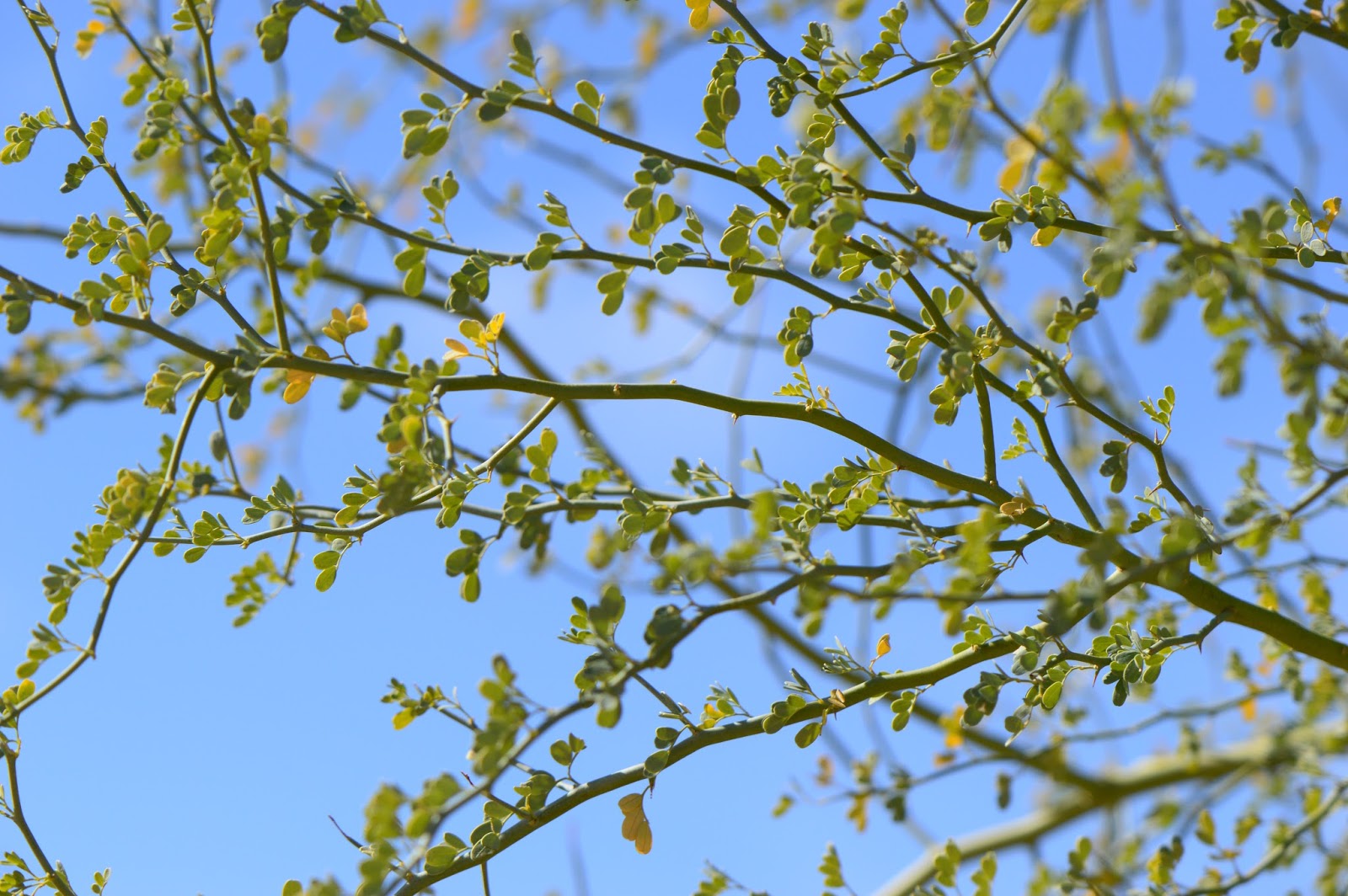
 ...though most of the leaves have a yellowish cast.  Looking back over past posts, I see that I've mentioned yellow leaves at least since November.  It would seem to be a winter phenomenon and has increased each month since.  These trees do not drop their leaves in our normally mild winters (they are summer deciduous instead to cope with drought), but it would seem that they do turn colour a little bit!
Parkinsonia florida, amy myers, small sunny garden, desert tree, palo verde, tree following, sonoran desert
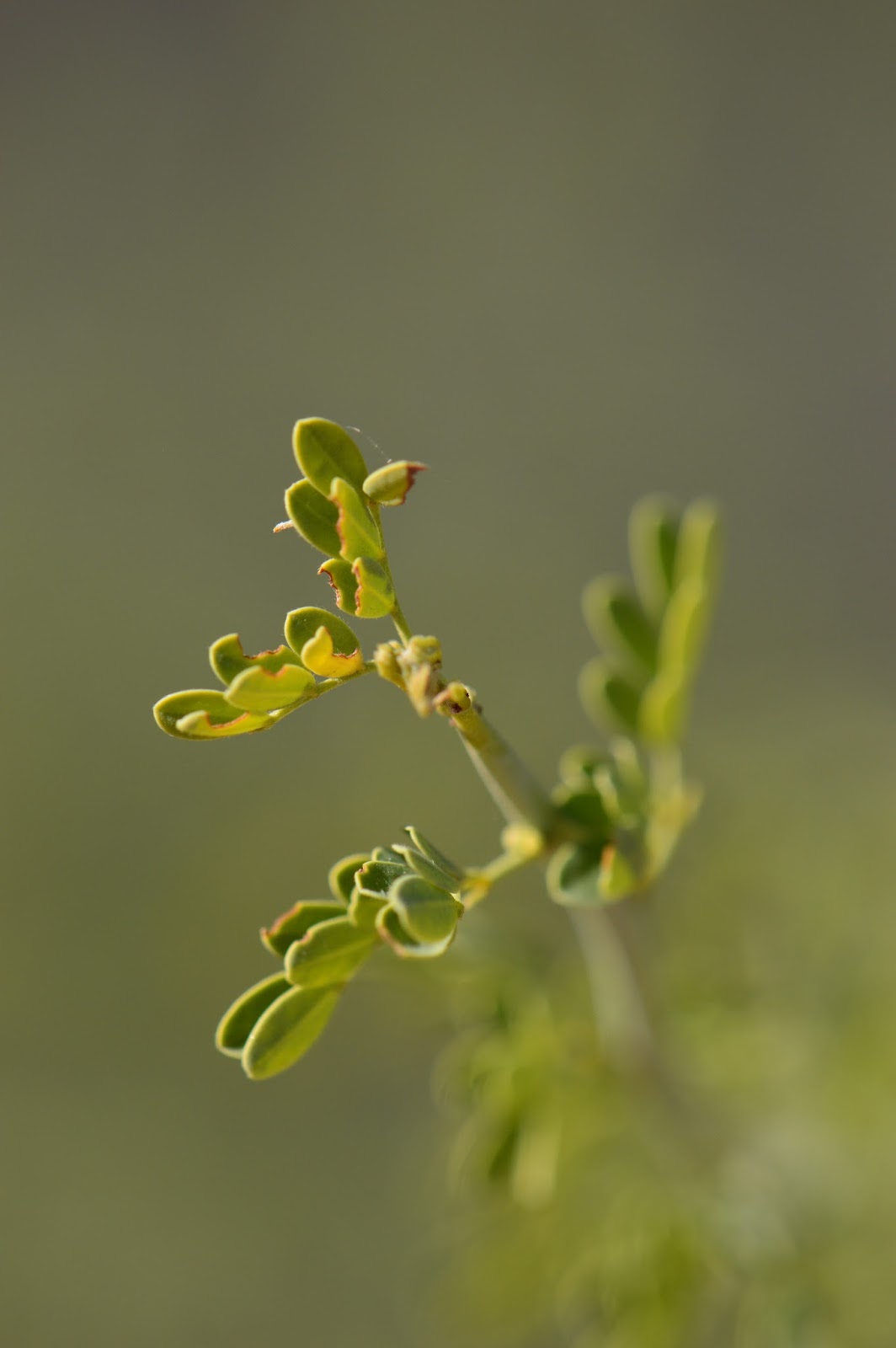
In the meantime, an answer has possibly emerged to a question from several months ago, namely, the question of folded leaves.  I think now this is a response to shade.  Many of the branches were already in shadow when I went to take my pictures.  The leaves on the shadowed branches were folded...
Parkinsonia florida, amy myers, small sunny garden, desert tree, palo verde, tree following, sonoran desert
...and even more dramatically here...
Parkinsonia florida, amy myers, small sunny garden, desert tree, palo verde, tree following, sonoran desert
...while those on the sunlit branches were still open.
Parkinsonia florida, amy myers, small sunny garden, desert tree, palo verde, tree following, sonoran desert
Definitely a sun-loving tree!  Though I can't be certain that shade is the cause...

For the rest, it is its usual self, with dainty, rounded leaves and green bark.
Parkinsonia florida, amy myers, small sunny garden, desert tree, palo verde, tree following, sonoran desert
The foliage has filled in since last month, which was quite dry.  January has already seen some good rainy weather so the trees can afford to put out some extra leaves.

While out, I was also able to take some pictures of the beautifully striped branches of the so-called Creosote Bush (Larrea tridentata); those pictures are up at the Journal of a Thousand Things.

Here is a last close-up of the somewhat yellowed leaves of the Palo Verde trees, lightly folded.
Parkinsonia florida, amy myers, small sunny garden, desert tree, palo verde, tree following, sonoran desert
Weather Diary: Fair with light clouds; High: 64 F (18 C)/Low: 36 F (2 C)

Thursday, November 12, 2015

The Wild Tree: November

Parkinsonia florida, palo verde, blue palo verde, desert tree, wild tree, sonoran desert, small sunny garden
I have been very slow to go around and check on the wild Palo Verde tree (cluster of little trees, really) that I'm watching for the Tree Following meme.  I assumed that there would be little change from last month, which is true, but there are some things to notice in November.

First, of course, it does not lose its leaves for the winter, which is relatively mild here and generally a good time for the plants.
Parkinsonia florida, palo verde, blue palo verde, desert tree, wild tree, sonoran desert, small sunny garden
So it is still fairly well-foliaged, with the occasional yellow leaf here and there.
Parkinsonia florida, palo verde, blue palo verde, desert tree, wild tree, sonoran desert, small sunny garden
More surprisingly, I spotted a stray bloom as I looked up into the canopy.  At first I thought it was only another yellowed leaf, but, no...
Parkinsonia florida, palo verde, blue palo verde, desert tree, wild tree, sonoran desert, small sunny garden
Here it is, a little closer, with its bright yellow petals and brilliant russet stamens...
Parkinsonia florida, palo verde, blue palo verde, desert tree, wild tree, sonoran desert, small sunny garden
There have been other spare blooms over recent months - no doubt why I found a couple of immature seedpods as well as a fully ripe one still on the tree.
Parkinsonia florida, palo verde, blue palo verde, desert tree, wild tree, sonoran desert, small sunny garden
The beautiful grey-green bark from which the species derives its common name of Blue Palo Verde (which translates very roughly to "blue green pole..." - "palo" seems hard to translate!) remains largely unchanged across the months, with wonderfully smooth-skinned branches behind a loose veil of tiny leaves...
Parkinsonia florida, palo verde, blue palo verde, desert tree, wild tree, sonoran desert, small sunny garden
...a few of which showed signs of having been munched...
Parkinsonia florida, palo verde, blue palo verde, desert tree, wild tree, sonoran desert, small sunny garden
...and some were folded today.  I don't know why, as we're not getting extreme temperatures in either direction at present.   But perhaps the tree is like me and finds it difficult to adjust to nights in the forties (Fahrenheit this time!) after a summer's worth of heat?  
Parkinsonia florida, palo verde, blue palo verde, desert tree, wild tree, sonoran desert, small sunny garden
But it's certainly beautiful weather, and the trees are thriving.

I hope I can still link this post to the meme, now kindly hosted by Pat at Squirrelbasket.  Thank you, Pat, for carrying on this wonderful idea!
Parkinsonia florida, palo verde, blue palo verde, desert tree, wild tree, sonoran desert, small sunny garden

Weather Diary: Sunny; High: 71 F (22 C)/Low: 42 F (6 C)