 |
| Notocactus leninghausii |
Showing posts with label plant photography. Show all posts
Showing posts with label plant photography. Show all posts
Tuesday, May 3, 2016
Friday, March 25, 2016
A Touch of Gold

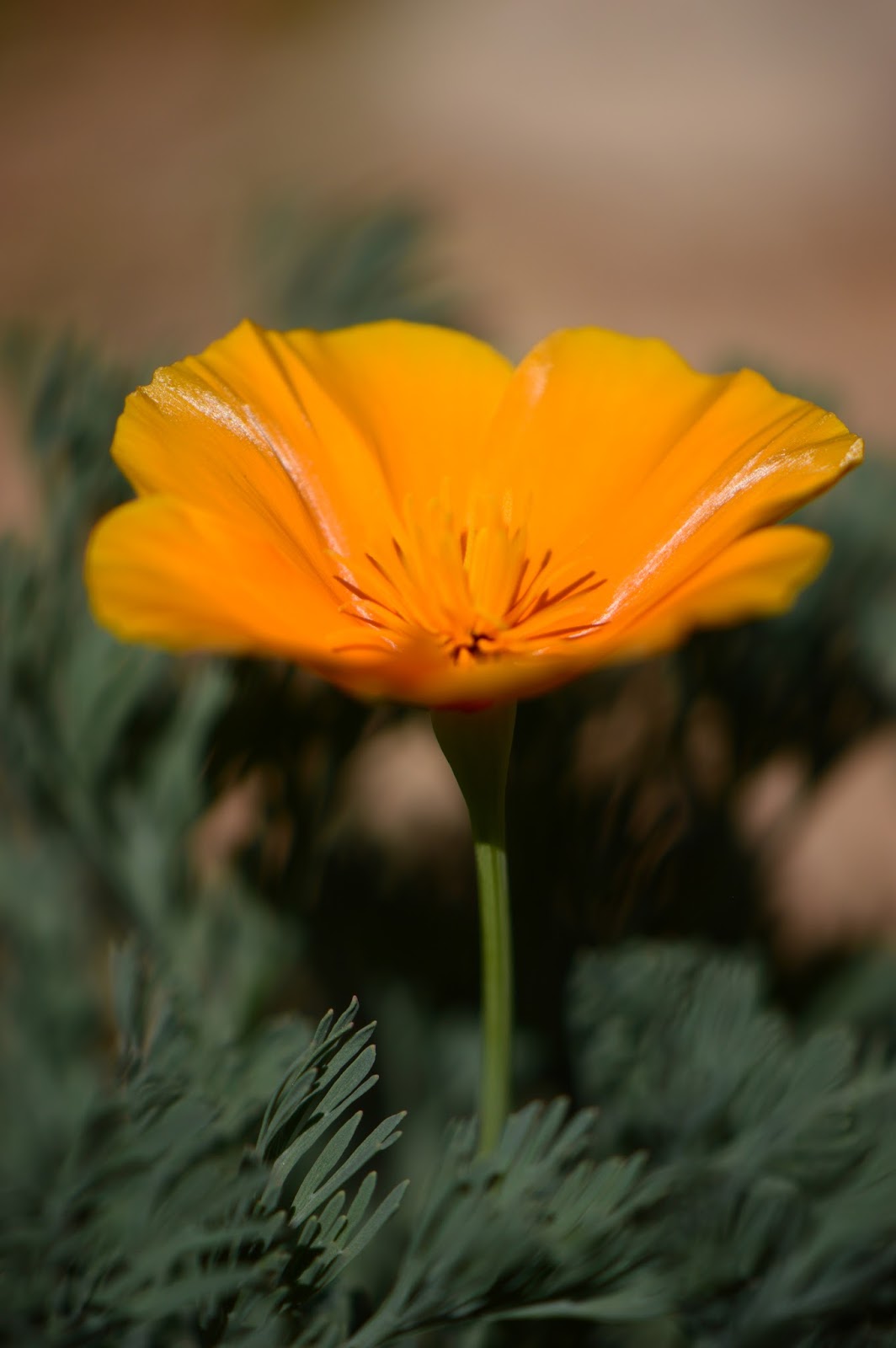
Just enjoying the first California poppy to bloom in the garden...

This is the simple species Eschscholzia californica, which I felt might have the best chance of growing really well in this garden. I seeded these back in January, unsure whether it was the correct time for this region. I felt I had better get the seed down, whether or no, as the packet had accidentally been soaked with water.
Apparently it was the right time, or close enough!

These golden beauties are taking over from the species narcissus to keep the East Border bright.
Posting this to join in with the "Favorites" theme with Loree at Danger Garden.
Saturday, March 19, 2016
Another Plant in Flower...

I missed posting pictures of cactus flowers in my Bloom Day post. Here is my recently planted Mammillaria elegans, just a very small mound of white and pink starbursts right now. And yes, quite elegant, I think!

Apparently I was not supposed to plant it out until the weather warmed up. However, it didn't seem to mind and has settled in. And as the weather is heating up nicely this week, I expect it to do well!
The spines seem to be more or less harmless, and the whole effect of the little plant is charming.

Tuesday, February 2, 2016
About the Desert Garden, Part 1
 |
| Saguaro cactus (Carnegiea gigantea) against a backdrop of the White Tanks mountains |
It's been over a year since I started the small, sunny garden. In the meantime I've learned a lot about the location and some of its idiosyncrasies. To begin, the garden resides just on (or beyond, according to many locals!) the northwest edge of the Phoenix, Arizona, metropolitan area. This places it in the northern section of the Sonoran Desert. So I'll begin with a look at this wider area.
The Sonora is the hottest of the North American deserts and at the same time contains the largest diversity of plant species. Native Sonoran plants range from the Saguaro cactus (Carnegiea gigantea, which occurs in the wild only in this desert) to riverbottom trees such as Arizona ash (Fraxinus velutina), to a host of shrubs and subshrubs and herbaceous wildflowers.
 |
| Carnegiea gigantea, the gentle giant of the Sonoran Desert |
 |
| Larrea tridentata, the shrub which lends its distintive, crisp scent to moist days |
 |
| Sphaeralcea ambigua, whose warm cup-flowers enliven the roadsides after rain |
northwestern sections of Mexico, where it extends at least to the Gulf of Baja (Baja California itself is now considered by many to be a separate ecosystem). Throughout this desert there are multiple subdeserts and a wide range of elevations, with the lowest point being California's Salton Sea, which lies below sea level.
There are now some major cities in the region, with Phoenix being the largest -- and a rapidly-expanding one. Others include Tuscon, AZ, and Palm Springs, CA, as well as Hermosillo and Saltillo in Mexico.
The region is home to a number of native American tribes; but the Hohokam, who originally erected irrigation canals in the Phoenix area, left them during the 14th century, as massive flooding and associated alterations of the Salt River destroyed the system or rendered it unworkable. The canals then lay more or less unused until the 19th century. As settlers and prospectors entered the area in the 1840's and '50's, the ancient canals were promptly repaired and expanded, providing arable land for crops of hay, cotton, citrus, etc. These supplies went to Fort McDowell to the northeast and to Vulture Mine to the west. Vulture Mine was the richest producing gold and silver mine in Arizona; shut down with other gold mines during the Second World War, it failed in a later attempt at a comeback and remains closed to the present day. In the meantime Phoenix became a transport and agriculture hub and eventually a major metropolis on its own account, growing out into the surrounding desert at a great rate. Job and retirement opportunities have fueled much of the growth, and the sunshine is offered as respite from cold, grey winters elsewhere in the country.
 |
| Cattle-ranching has also been a major factor |
Rain is, of course, scarce -- about 7 in/18 cm annual rainfall on average -- and occurs over two separate periods during the year. The largest amounts come in the summer monsoon season, the first relief from the searing heat of June. Though temperatures in July and August remain high, the rain and associated humidity offer a respite to plants (and mosquitoes!). The second period is during winter. But the rainfall is in any case too widely spaced to sustain grass cover, let alone heavier vegetation. The soil is basically dry; and without the water to flush mineral build-up away, it is often alkaline and to some degree salty.
Soils can range from sandy and rocky to clay. In some locations, such as hillsides, it can include caliche, which is a layer of calcium carbonate hardpan. Thin layers can be broken up; thick layers (sometimes over three feet deep) present a serious challenge to plant-growing. Clay replaces lighter soils as one moves away from mountains.
 |
| There are many mountainous upthrusts across the area. These are the Vulture Mountains, which take their name from the Vulture Mine |
All of which creates the unmistakable growth patterns of the Sonoran Desert. Scrubby desert shrubs spaced sparsely across rocky or gravelly hillsides and plains. Thickets of little trees in low areas, leafless in the drought of summer, but flourishing in the rains that flood across the land periodically. Tall stands of cactus looking out at the sun. Low-growing agaves, whose shallow roots collect the water where it is -- at the surface -- and whose heavy leaves store the water against the many dry days ahead. Sweeps of wildflowers that suddenly bloom, then dry and blow away on the ever-present wind.
 |
| Kallstroemia grandiflora was abundant during the exceptionally wet summer of 2014 |
It is a beautiful land. But certainly it is an intimidating one for the gardener. And information must be collected haphazardly as one finds books and knowledgeable gardeners because there is simply not the storehouse of old wisdom nor centuries' worth of gardening tomes. I am collecting my own little storehouse -- one year's worth now -- here on the blog. It's already been wonderful to be able to go back and check my own records and theories; and perhaps it will be helpful or at least interesting to other gardeners, in the region and out of it!
 |
| Looking up at a Saguaro cactus (Carnegiea gigantea) |
Friday, January 29, 2016
The Amaryllis Adventure

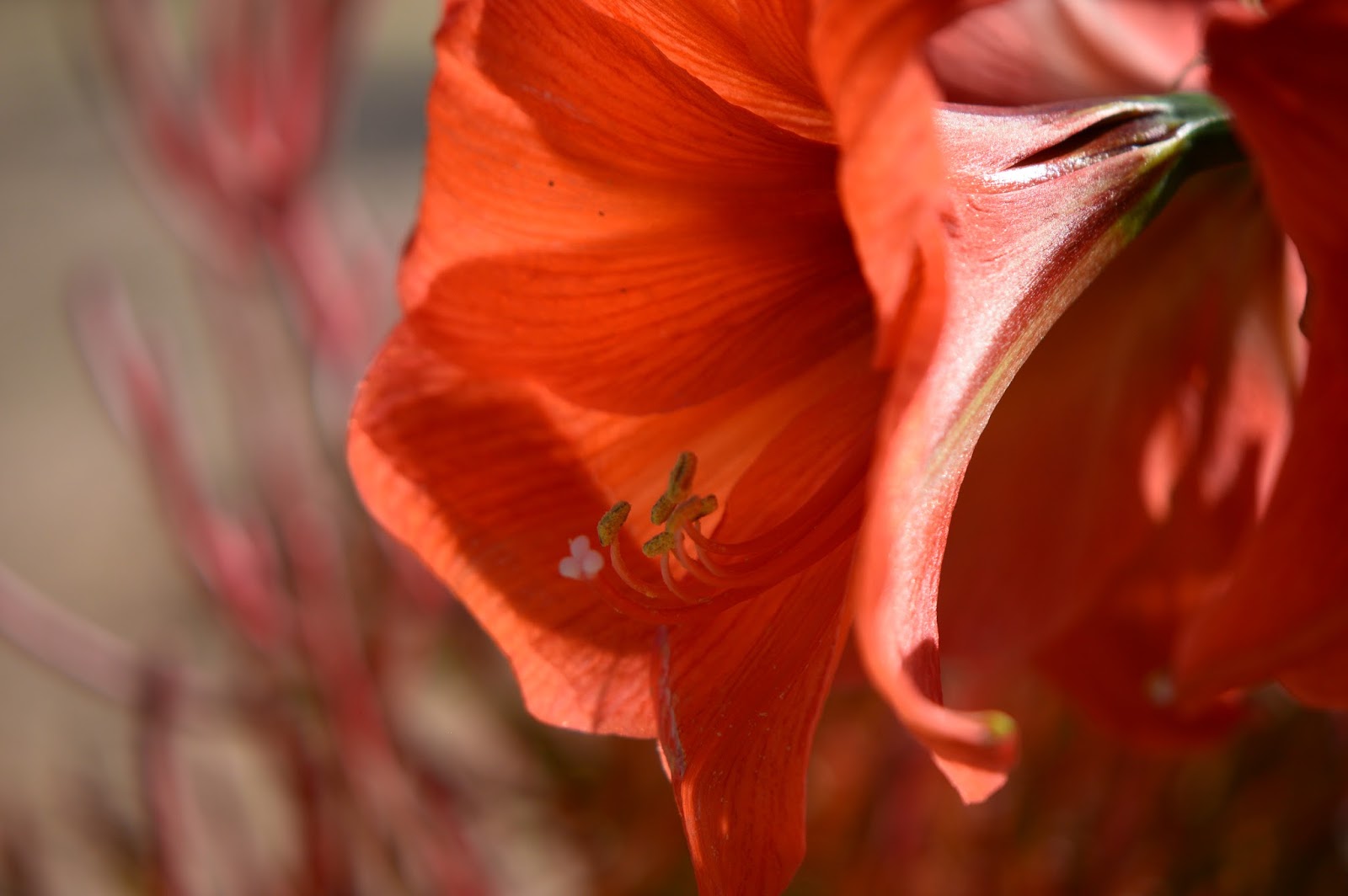


In good time for last Christmas, I ordered myself a single Hippeastrum bulb.
This is becoming a sort of personal tradition: first, because I love amaryllis and second, because I've never had any success bringing them back into bloom for a second year. Leaves, yes, old leaves that never really die, but no flowers. There is a sort of frustration to it because I will also never admit that I'm using the plant strictly as an annual. I must try to carry each bulb through to a second flowering; I can't leave well enough alone. I am sure that many of my difficulties stem from very warm house temperatures and low indoor humidity. However, I can't change those factors very well.
So first there is the glorious anticipation, culminating at last (hopefully just at or before Christmas) when the enormous, brilliant flowers burst fully open on their long stems. Then there are weary months of wondering when I will stop attempting to salvage another bulb for another season.
This time I selected the variety "Naranja" - a very apt name as the flowers are even more orange than their namesake fruit. The bulb came promptly and was duly planted in a smallish pot as per all advice. But this time, with the mild winter temperatures here, I determined to try leaving the pot out of doors to enjoy some real, fresh air.
With results according.
The plant grew much more slowly; in fact, it has only flowered in the last week, over a month later than usually expected. But the stems and leaves (not much from these yet) are also a good deal shorter and therefore sturdier. As for the blooms, they are spectacular...
I have little doubt that the plant has been much more comfortable outside than it would have been in, though I did miss the very direct Christmas anticipation of growing it indoors.
The rest of the story involves the previous year's amaryllis. I kept it in its pot and continued, as described above, caring for it until its languid and floppy leaves made me decide it had better not stay around the living room at any rate. Then I transfered it out to the patio and continued watering and occasionally feeding it. Last autumn I decided to try another tack, so I went ahead and planted the bulb, still with lank green foliage, in the garden. The leaves eventually died off, but a couple of slender leaves came sprouting up from what must be a bulblet. Well and good.
And then, three days ago, I found a short spike of green leaf coming up from the original bulb. Whether or not it will bloom this year, it has at least completed a full cycle of leaf to leaf, the thing I could never coddle my amaryllis bulbs to do in the past. I am told amaryllis can thrive - perhaps even naturalise - in the garden here, and I am hoping it is beginning to happen.
I know where "Naranja" is going once its luscious blooms begin to fade! (But wait, it has a second bloom stalk!)


Wednesday, February 18, 2015


Thursday, February 5, 2015
Tiny Things

Here is a glimpse of the garden through my new lens...
Above, the marguerite daisy (Argyranthemum frutescens) with a bee...
Below, newly planted Armeria...


Eremophila "Valentine", an open trumpet with its dark stamens...


I want to add a "thank you" to Julie at Peonies and Posies for thoughtfully answering my questions about her new lens. Her reply encouraged me to make what is proving a good decision: a lightweight lens with vibration control and a little macro.
There has been a bit of a learning curve; for instance, point of focus is much more critical. But I am thoroughly enjoying the results...
The growing tip of a just-planted rose, "The Generous Gardener" (David Austin, 2002)...


Saturday, January 3, 2015
Winter Morning Walk: Wild Palo Verde

To the best of my knowledge, this is the Blue Palo Verde (Parkinsonia floridum). In a few months there should be flowers, but for now there are only the tiny leaves and the grey-green bark. Green bark colour is typical of the Parkinsonias, which often drop their leaves during the summer heat and drought, while the bark carries on the task of photosynthesis. In some species, the bark colour is brighter or yellower, but this tree has skin of a soft grey-green tinted with blue. Even now the leaves are fairly sparse, and some are a bit yellow. I don't know whether this is from the cold snap or not, but in any case it gives a brilliant effect as the sun shines through them.


Subscribe to:
Posts (Atom)