|
| A corner of the East Border in early spring. Senna nemophila and Berlandiera lyrata |
For this last post in the
About the Garden series, I am looking at the basis for plant selection here in the Sonoran Desert. When I began thinking about making this garden, I tried to research just how to do it. I looked for books. I looked for blogs. Results were sparse. This is actually one reason I began my own blog: I felt that even if I were only twelve months ahead of the next desert gardener, I might have some useful information or, more likely, cautionary tales. Whether or not this has happened, I have certainly
received a good deal of helpful and encouraging information via the blog, so it was certainly a good idea!
In retrospect, I really did expect to find more books on the subject: perhaps,
Encyclopedia of Plants for the Desert Garden or
The Beginner's Guide to Desert Perennials or some such thing. Or blogs presenting the accumulated experience of someone's dozen years of Phoenix gardening. (Even Tuscon would be helpful!)
In the end I had to simply use my best judgement and get the garden going. Since then, I have found a handful of very helpful books and some equally helpful advice from bloggers and Instagrammers. But for all that, I've found my starting point was a good place to continue working from.
So here it is.
Various garden authors have stressed how important it is to select plants that originated in climates and regions fairly similar to our own. This way plants are more likely to succeed and more likely to look appropriate in their settings. In the case of the desert garden, this is made more difficult by the fact that there are not so very many desert regions producing commercially available plants. Collectors have brought some gems into horticulture; but even so, it takes a while to produce demand for ornamental garden plants in these regions, many of which have only recently -- if ever -- had significant human settlement. Some of the best plants I have are fairly recent introductions to the world of gardening.
Because of this paucity, it has been necessary to stretch the idea of similarity a bit. As things stand, I divide the really useful sources as follows: native desert, Australian, and Mediterranean, with occasional forays to the new world tropics and to Africa.
 |
| The South Border contains mostly Mediterranean and Australian plants |
Native Desert Plants
This is, of course, the single most important source. The available native plants represent a range of regions as there are three major deserts in the US: the Sonoran, the Mojave, and the Chihuahuan, each with different climate trends.
Native Sonoran plants are obviously a good choice. Not only are they likely to be extremely drought-and-heat-tolerant, but their growth habits suit the weather patterns of the locale. Additionally, they are built to withstand the unusually strong sunlight of this region. This makes them desirable plants even if their normal habitat is from settings that naturally receive some extra moisture.
Plants from the Mojave are fewer and may demand completely dry conditions in summer -- a requirement which cannot be met by the weather patterns of the Sonora, with its July and August rains. So far as I know, I have not yet added any Mojave natives to the garden.
Oddly enough, many of my best plants come from the Chihuahuan Desert. The Chihuahuan Desert has produced a number of excellent plants that have become staples in the nursery trade across the Southwest. This desert is rugged interior country in New Mexico and Texas, then south into eastern Mexico. Coming from higher elevations, plants from this region are often hardy at least down to 10 F (-12 C). Although in their native region they are rarely exposed to the extremely high temperatures common in the Sonora, they tend to be very reliable in the heat, drought, and single-digit humidity of the low desert. They are also well-adapted to alkaline soils.
Some native desert plants in the garden:
Vauquelinia californica (Sonoran)
 |
| Vaquelinia californica |
Calliandra californica (Sonoran)
Penstemon parryi (Sonoran)
 |
| Penstemon parryi |
Chilopsis linearis (Sonoran)
Leucophyllum frutescens (Chihuahuan)
Chrysactinia mexicana (Chihuahuan)
Salvia greggii (Chihuahuan)
Berlandiera lyrata (Chihuahuan)
Australian Plants
I cannot say enough nice things about the Australian plants I have grown. So far I have found them as reliable under garden conditions as the natives. Requiring little supplemental water and sustaining the heat and sunlight admirably, they are a stalwart presence in the garden. I rely on them equally with the natives for structural plants.
It is, no doubt, a woeful generalization to simply say "Australian" plants. They come from a continent with a full range of geographical and climatic regions. However, not much distinction is made, even in online sources. I think there is a slight preponderance of Western Australia plants in the garden so far, though Acacia salicina and Ozothamnus diosmifolius are from the eastern part of the continent and Eremophila maculata is said to be common throughout inland Australia. To be honest, if a plant is sold here as a native of Australia, I tend to assume it will be well-adapted in my garden, barring problems with cold tolerance.
One pleasant feature of adding Australian plants is the colour of the foliage. I have mentioned this in earlier posts; but I find it fascinating that, while the American desert plants often have very muted leaf colours, Australian plants sometimes sport bright green foliage, which adds a much lighter note to the garden. Some are worth growing for the foliage alone. Then there are the plants with spectacular bloom, from the bright pink of Eremophila maculata varieties, such as "Valentine", to the rich blue of Alyogyne huegelii.
Australian plants in the garden
Eremophila maculata "Valentine"
E. "Outback Sunrise"
Acacia salicina
Mediterranean Plants
A very interesting remark is made by Mary Irish in her book
Gardening in the Desert. She notes that when Mediterranean plants grow well here in the desert, they tend to grow very well. This, from a very experienced desert grower, is probably the best possible statement on plants from the region. While they are rarely exposed, in their native habitat, to the temperatures or low humidity typical in the Sonoran Desert, they are often very resilient plants. In addition, they are frequently salt-tolerant: no small advantage for desert growing! I imagine, in fact, that there may be many classic Mediterranean plants that would perform quite well in the Sonoran Desert -- far more than are readily available. I am depending heavily on two of them at this point: rosemary and lavender. Culinary sage has also done beautifully, as has Artemisia "Powis Castle", which could, I suppose, be classed as Mediterranean. And the region is a good source for spring-blooming bulbs which may not require winter chill.
Mediterranean plants in the garden:
Rosemary “Tuscan Blue”
Lavandula stoechas varieties
Lavandula “Goodwin's Creek Gray”
Salvia officinalis
Convolvulus cneorum
Cupressus sempervirens “Stricta”
Narcissus x odorus
Tulipa saxatalis
African plants
A few comments may be worthwhile about plants originating in
Africa. Initially I shied away from them; after all, southern Africa
(home of many of the “African” species available to gardeners)
has a much more salubrious climate than the Sonoran Desert.
Nevertheless, some crept into the garden, then some more. And
northeastern Africa does produce some valuable plants for the desert
garden as well. To make things more confusing, many south African
plants perform beautifully in coastal southern California, the
nearest major gardening climate to mine… similar in many ways, but
so different in others.
On the whole, with African plants it has been touch and go, try
and succeed… or fail. After failure (or at best, very limited
success) with bulbous and cormous plants such as Galtonia candicans
and Crocosmia, two other plants encouraged me to keep planting
African species. These were the simple Argyranthemum frutescens, the
classic daisy, and Dietes iroides, the Fortnight Lily. Both have
performed well, and the Argyranthemum surprised me by surviving last
summer despite predictions that it would prove an annual in desert heat. This year I will be testing Kniphophia, which is said to grow
well here, and Agapanthus, which is not! I'll also be making a
second try with Crocosmia. I thought perhaps it was just gardener
error last summer as Crocosmia is proverbially tough, but I have
recently read otherwise – of course, just after I had placed the
order.
A range of African aloes are commonly grown here, with filtered shade recommended for
most varieties. I am just beginning with Aloes so have little to
report as yet.
Some African plants in the garden:
Argyranthemum frutescens
Dietes iroides
Aloes
 |
| Aloe "Blue Elf" |
Euphorbia tirucalli “Sticks on Fire”
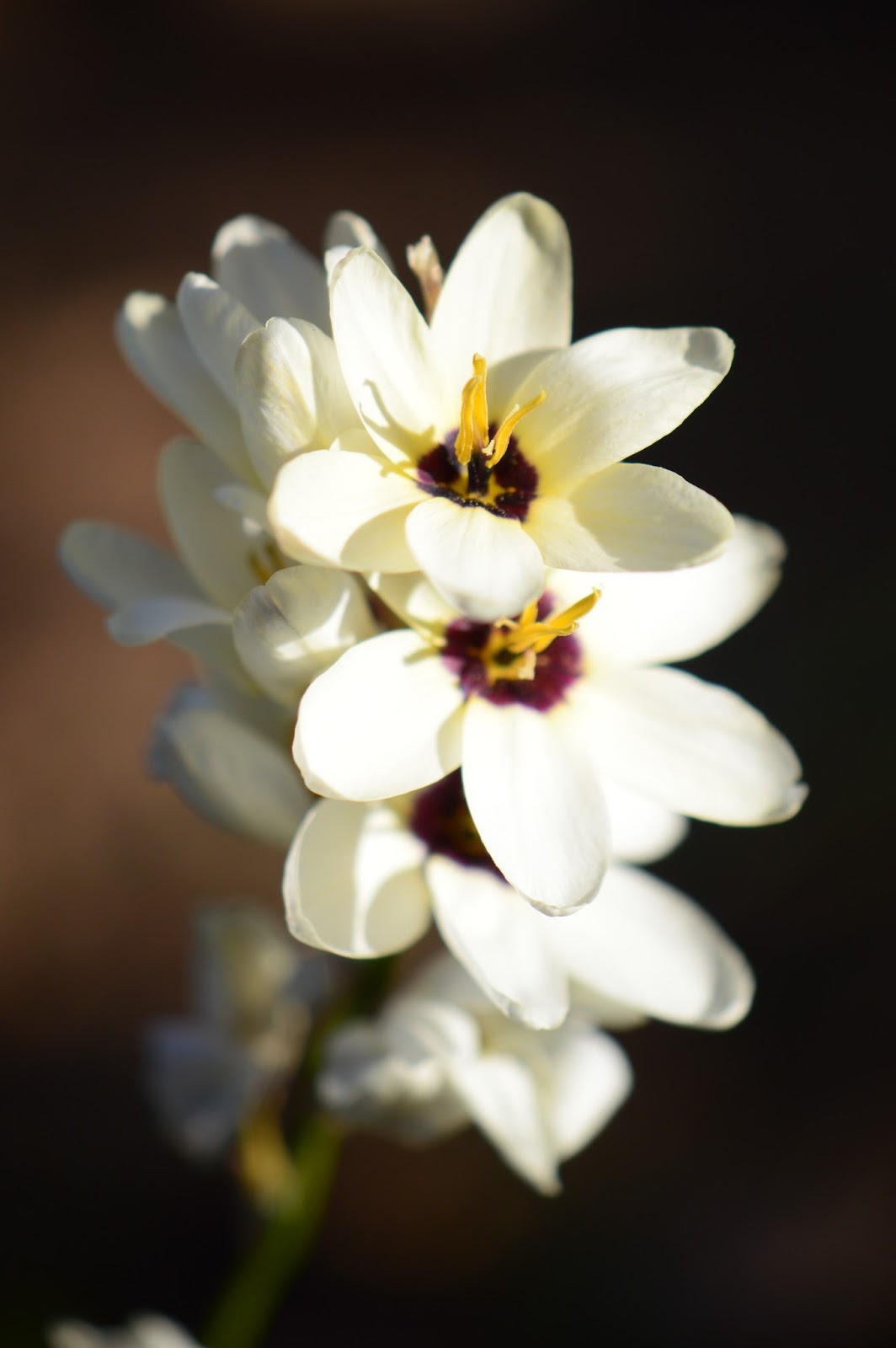
Ixia hybrid
Plants from the Tropical Americas
I would have assumed that plants from the
tropics were unlikely to grow well in the desert. The first indication
otherwise came from an early addition to the garden: Russelia
equisetiformis, originating in Mexico and Guatemala. It was one of
those must-have plants. I had never seen it before and fell in love
with its coral-coloured trumpets and brilliant green stems dotted
with tiny leaves. I slipped it directly under the patio eaves in
order to give it as much protection as possible, and it has repaid
this prime position many times over. Never entirely out of bloom, it
provides luscious colour for me and plenty of nectar for
hummingbirds.
And as the garden grew, I found other tropicals to try. They are
resilient in the heat and can tolerate summer moisture from monsoon
storms. Many are surprisingly undemanding in the matter of water.
Two considerations apply: drought tolerance and cold tolerance.
If a tropical is sufficiently easy-going in both aspects, it may be
worth a try. There have been failures: Cistanthe grandiflora died
off during last summer (though I should like to give it another go),
but on the whole I've been pleased with the plants I've tried from
this group.
New World Tropical plants in the garden:
Agave angustifolia
Russelia equisetiformis
Hamelia patens
 |
| Autumn colour on Hamelia patens |
Hippeastrum hybrids
 |
| Hippeastrum "Ambiance" |
Caesalpinia pulcherrima
Ruellia brittoniana
Conclusion
All in all, I feel that the chief factors in plant selection are as follows: heat tolerance, water requirements, exposure, humidity, and winter chill. Selecting from regions with general resemblance to my own increases the chances of meeting these requirements.
But there are the mavericks that give stellar performance anyway. Oenothera lindheimeri (formerly Gaura lindheimeri) from Texas and Louisiana.
Muhlenbergia capillaris from the eastern and central US.
Perovskia atriplicifolia and Stachys byzantina from Central Asia. Lagerstroemia indica from Southeast Asia. And so on. Despite their provenance, they meet the growing requirements readily.
So what do these requirements mean here in the small, sunny garden?
Heat-tolerance: Plants must be able to survive extended periods of temperatures over 100 F (38 C). Very few plants actually thrive during these periods (even natives), but they must be able to either rest or get along somehow!
Water requirements: Drought-tolerance can vary, but a plant that requires a great deal of water cannot be kept going in this garden. The wilt, water, wilt, water sequence doesn't work for very long!
Exposure: This is one thing that I can modify to a degree. I am trying to ensure that shade is available throughout the garden. But resilience in the matter of intense sunlight greatly increases the chances of success -- one reason why Australian plants are so successful here, I suspect.
Humidity: On the other hand, there is little that I can do to drastically increase the humidity, so this is one area where plants need to be well-adapted.
Winter chill: In the matter of winter cold, I must walk a fine line. Plants are likely to be exposed to some freezing temperatures; on the other hand, they will not receive the type of chill necessary for many temperate climate plants, such as peonies or border tulips or many of the stone fruits. Because the amount of cold required for a given plant is not always among the attributes commonly listed, this is another point where guesswork is sometimes the order of the day.
And each of these factors influences the others, creating the dynamic beauty that we call a garden. One must work with it. It is a beauty that changes from season to season, from year to year, even in the same spot with the same plants growing.
That is gardening!
 |
| Penstemon parryi |
Weather Diary: Partly cloudy with rain showers; High: 88 F (31 C)/Low: 61 F (16 C)